Bipolar Disorder: Mitochondrial Energy Instability as the Root of Mood Cycling
Bipolar disorder is, at its metabolic core, a disease of unstable brain energy production. Five people who stabilised their mood cycling through ketogenic therapy targeting the mitochondrial dysfunction at the heart of the condition.
TL;DR
Mitochondrial dysfunction, circadian disruption, dopamine/NE oscillation. BHB bypasses complex I defects. Stanford pilot data. Five cases: bipolar I, rapid cycling, comorbid T2D, treatment-resistant, schizoaffective.
The physiology
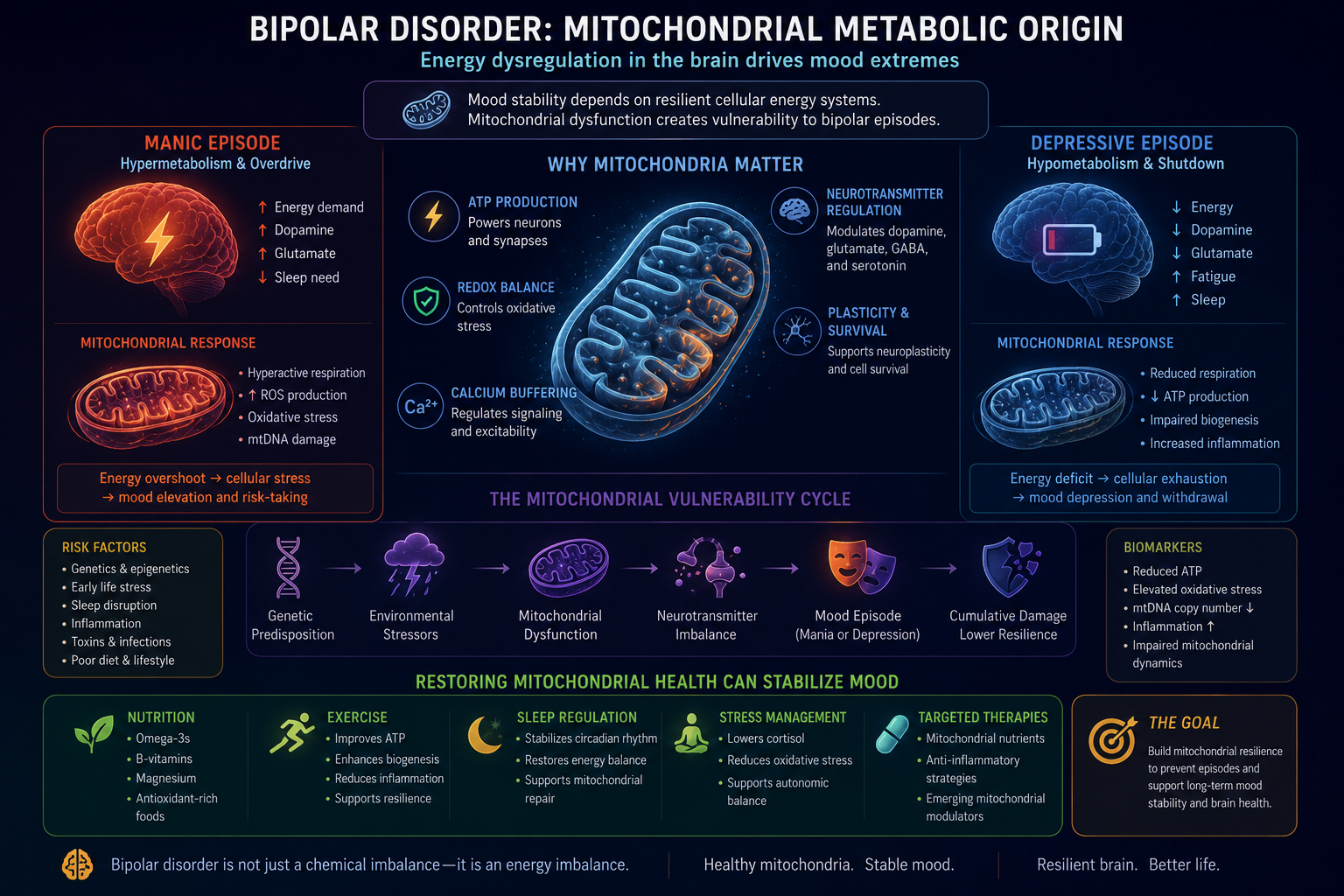
Bipolar disorder is, at its metabolic core, a disease of unstable brain energy production. Mitochondrial function in neurons is impaired — ATP production fluctuates in ways that destabilise circuit activity throughout the brain. Dopamine, norepinephrine, and serotonin systems swing dramatically as a function of that energetic instability. The manic phase corresponds to a state of dysregulated hyperactivation; the depressive phase to energetic collapse. The circadian clock, tightly coupled to metabolic cycles, loses its regularity and amplifies both poles.
"We're starting to see some pretty impressive results from ketogenic therapy to treat serious mental illness, bipolar disorder, schizophrenia, major depressive disorder, and others."
Ketogenic therapy provides mitochondria with beta-hydroxybutyrate — a more efficient fuel than glucose that enters the mitochondrial energy cycle directly, bypasses the complex I dysfunction documented in bipolar neurons, and produces approximately 25% more ATP per oxygen molecule. Stanford's pilot trial (2022–2024) found that bipolar patients on a ketogenic diet achieved measurably better metabolic health scores and self-reported mood stability superior to their standard medication regimen.
Five stories
James — Classic bipolar I
James, 42, had been hospitalised twice for manic episodes and spent nearly fifteen years cycling between the poles. Lithium helped blunt the peaks but left him in a permanent fog. After reading early research from the Nourished by Science group, he negotiated with his psychiatrist to add a strict ketogenic diet to his lithium maintenance. The cycles did not stop immediately but their amplitude narrowed over six months. He has not been hospitalised in three years and describes his thinking as clearer than at any point in adult life.
Nina — Bipolar II with rapid cycling
Nina, 34, had rapid cycling — four or more mood episodes per year — that made sustained employment impossible. Her psychiatrist had tried five mood stabilisers over ten years with partial effect. She began ketogenic eating after seeing a Metabolic Mind talk. Within four months the rapid cycling slowed to two episodes in the year. She attributes the stabilisation to the mitochondrial fuel switch — her hypothesis, shared by her psychiatrist, is that her neurons had been caught in an energetic instability that standard pharmacology could not address.
Ray — Bipolar with comorbid insulin resistance
Ray, 50, had both bipolar disorder and type 2 diabetes. His psychiatrist noted the conditions were worsening each other. Insulin resistance in the brain — a finding consistent with both diseases — was the proposed shared mechanism. A ketogenic diet addressed both simultaneously. His HbA1c normalised within three months; his mood stability improved in parallel. His psychiatric medication was halved at the one-year mark without deterioration in mood control.
Adele — Treatment-resistant bipolar
Adele, 29, had been diagnosed at 19 and had never achieved sustained remission on any medication combination. Her psychiatrist described her case as treatment-resistant. She enrolled in an open-label ketogenic diet study. After a difficult first month of adaptation, her mood logs showed a pattern unlike any previous treatment — not merely blunted oscillation but genuine periods of stable baseline mood extending weeks at a time. She remains in the study and on strict ketogenic nutrition.
Tom — Bipolar with psychotic features
Tom, 38, experienced psychotic episodes during severe mania that required antipsychotic medication. The antipsychotics produced metabolic side effects — weight gain, elevated triglycerides — that worsened his underlying mitochondrial dysfunction. His metabolic psychiatrist introduced ketogenic nutrition to address the medication-induced metabolic damage. The dual benefit — mood stabilisation plus reversal of medication metabolic effects — was achieved over twelve months. His antipsychotic dose was reduced under close supervision.