Anxiety Disorders: Amygdala Hyperactivation and the GABA Deficit
Anxiety disorders begin with a failure of inhibitory GABA tone over the amygdala. Five people — generalised anxiety, panic, social, health anxiety, mixed — who found relief through ketogenic and metabolic intervention.
TL;DR
Amygdala hyperactivity, GABA deficit, cortisol dysregulation. Ketones raise GABA via astrocyte conversion. Five cases: GAD, panic disorder, social anxiety, health anxiety, anxious-depressive.



The physiology
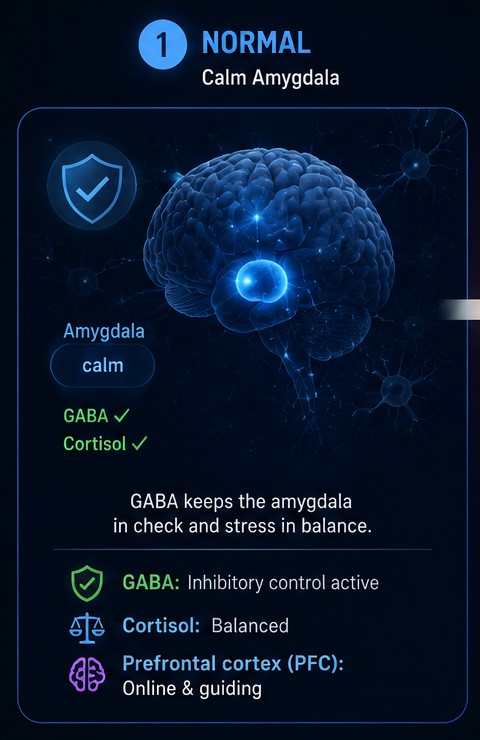
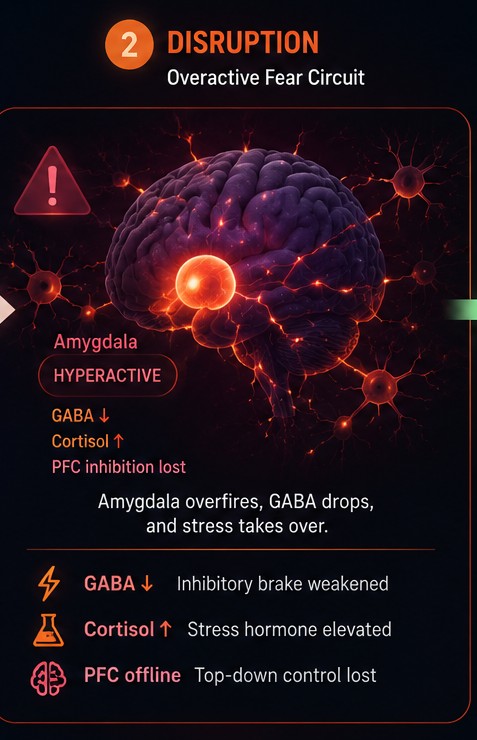
Anxiety disorders originate in a failure of inhibitory control over the amygdala — the brain's threat-detection hub. Gamma-aminobutyric acid (GABA), the primary inhibitory neurotransmitter, normally keeps amygdala firing in proportion to actual threat. When GABA function is impaired — through receptor downregulation, magnesium deficiency, chronic cortisol exposure, or neuroinflammation — the amygdala generates fear signals in the absence of real danger. The prefrontal cortex, which would ordinarily inhibit those signals, is itself undermined by the same metabolic compromise.
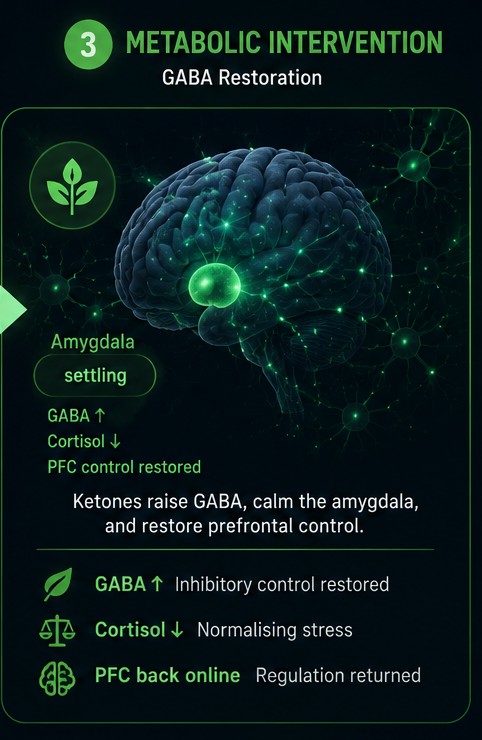
Ketogenic nutrition raises brain GABA levels through two mechanisms: BHB is converted to glutamate and then to GABA in astrocytes, increasing the substrate available for synthesis; and ketosis reduces the excitatory glutamate:GABA ratio by suppressing NMDA receptor activity. This is the same mechanism that makes ketogenic diet effective in epilepsy — a condition of neural hyperexcitability with close mechanistic overlap with anxiety disorders.
Five stories
Sofia — Generalised anxiety disorder
Sofia, 31, had generalised anxiety disorder severe enough to prevent her working full days. Her thoughts ran in circles; her body was in a state of permanent low-level alarm. After a course of CBT produced only partial improvement, her therapist referred her to a metabolic psychiatrist. She began a strict ketogenic diet. Within six weeks the baseline hum of anxiety had quietened noticeably. Within six months she described it as having gone from a loud radio she could never turn off to occasional static she could ignore.
Rashida — Panic disorder
Rashida, 27, was having three to four panic attacks per week — episodes of cardiac pounding, breathlessness, and overwhelming dread lasting twenty minutes each. She declined benzodiazepines on grounds of dependence risk. Working with a functional psychiatrist, she implemented ketogenic nutrition alongside magnesium supplementation. The panic attacks reduced to one per fortnight within two months. By month four they had stopped entirely. She attributes the cessation to the GABA-raising effect of sustained ketosis.
Omar — Social anxiety
Omar, 22, had avoided social situations since adolescence. Job interviews, dinner parties, any unscripted interaction produced anticipatory dread that left him homebound most evenings. He began a ketogenic diet as part of a broader metabolic health experiment. The social anxiety did not disappear but its intensity dropped enough that exposure therapy — previously too overwhelming — became feasible. He completed a full course of CBT and holds a position that requires daily client interaction.
Cleo — Health anxiety
Cleo, 35, checked her body for symptoms compulsively, spent hours each day on medical websites, and made frequent emergency room visits for symptoms her doctors described as autonomic arousal. No amount of reassurance changed the underlying drive. After her nutritional biochemistry was assessed, she was found to have chronically low magnesium and elevated inflammatory markers. Dietary correction plus ketogenic nutrition brought both into normal range. The health anxiety reduced in proportion to the fall in inflammatory markers.
Dev — Anxiety comorbid with depression
Dev, 40, presented with what his psychiatrist described as a mixed anxious-depressive state — too wired to sleep, too exhausted to function. Antidepressants made the anxiety worse; benzodiazepines blunted him completely. A ketogenic intervention was introduced carefully, with gradual carbohydrate reduction over four weeks to avoid electrolyte disruption. The anxiety-depression tandem separated over three months — both improving as his brain's metabolic state stabilised — and he eventually tapered off medication with medical oversight.