Autoimmune Disease, Trauma, and How Childhood Shapes the Body
Physician and trauma researcher Gabor Maté argues that autoimmune disease is rarely a random biological misfortune — it is the body saying no to a lifetime of suppressed emotion, stress absorbed in childhood, and a self that learned to put everyone else first.
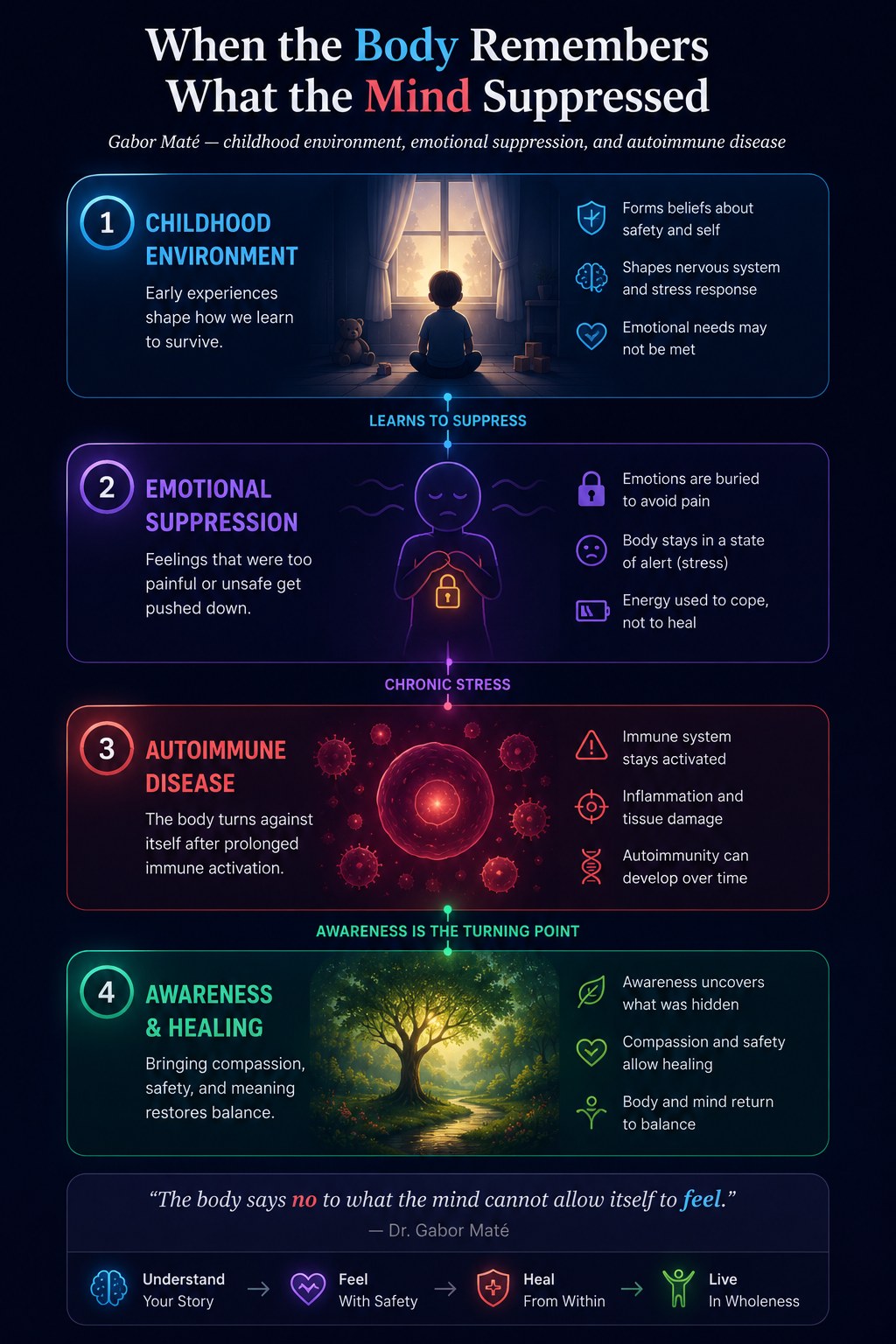
"I can guarantee you," Dr. Gabor Maté tells a packed audience, "that any of you here who've had chronic illnesses of any kind — you're going to recognize yourself in this talk. Completely and 100%. And you're going to wonder: why didn't anybody say this to me before?"
Maté spent twenty years as a family physician in Vancouver, including seven years as medical coordinator of a palliative care unit. What he observed, over and over, contradicted what he had been taught in medical school: who got sick and who didn't was not accidental.
The Personality the Body Pays For
Western medicine tends to treat autoimmune diseases — rheumatoid arthritis, lupus, multiple sclerosis, scleroderma, inflammatory bowel disease, chronic asthma, fibromyalgia — as distinct biological disorders to be managed with immunosuppressive drugs. Maté doesn't dispute the biology. He asks a deeper question: why does the immune system of certain people turn against their own tissue in the first place?
In palliative care, watching people die of cancer and autoimmune disease, he kept finding the same personality constellation. He is careful not to say these traits cause illness — that would be too simple. But they contribute to onset "significantly," and in thirty years of clinical work he says he has never found an exception.
The four patterns he identified:
- Automatic concern for others while suppressing your own emotional needs. The woman just diagnosed with breast cancer whose first thought is: "I'm worried about my husband. How will I support him?" She is the one about to go through chemotherapy.
- Rigid identification with duty, role, and responsibility. The physician who notices his blood pressure rising while finishing a book — because his identity is fused with being productive, and anything that interrupts that is experienced as threat.
- Repression of healthy anger. Maté distinguishes carefully here: healthy anger is simply a boundary defense — "You're in my space. Get out." It does its job and dissolves. People who "never get angry," who are described by their families as selfless and saintly, are not free of anger. They are imprisoned by it, turned inward.
- Two potentially fatal beliefs: that you are responsible for how other people feel, and that you must never disappoint anyone.
These patterns appear in the obituaries Maté reads aloud in his talks — Canada's most admired citizens, eulogized for their selflessness, their tireless dedication, their inability to ever say no. "We value in other people exactly what kills them," he says.
Nobody Is Born This Way
The crucial point: these are not character flaws or genetic predispositions. They are adaptations. No infant arrives in the world reflexively suppressing its own needs. Every newborn announces its hunger and discomfort without apology. The compulsive self-erasure that shows up decades later in the body as autoimmune disease was learned — it was the child's only strategy for maintaining connection with the people it depended on for survival.
"If your parents are alcoholics," Maté explains, "you're going to end up as a caretaker by age four or five. You're going to be an emotional caretaker by suppressing your own needs. And that's going to show up in illness of mind or body later on in life."
The child doesn't choose this. It is, in the most literal sense, a survival adaptation. In an environment where the parent's emotional state is fragile or threatening, the child learns to monitor the parent's feelings rather than its own. It learns that its job is to be good, to be helpful, to take up as little space as possible. The self gets compressed to make room for the adults. And the compression doesn't lift when the child grows up — it just moves underground, into the body.
Maté's Own Story
Maté doesn't offer these ideas from a comfortable distance. He was born in Budapest in 1944, two months before the German Army occupied Hungary. His mother called the pediatrician the day after the occupation. "Would you please come and see Gabor — he's crying all the time." The doctor replied: "Of course I'll come. But all my Jewish babies are crying."
His grandparents were killed in Auschwitz. His father was taken to forced labor. To keep him alive, his mother handed him to a stranger on the street for six weeks. He doesn't remember this. He doesn't need to.
"When mothers are stressed or in pain, the infant feels all that and takes it personally. It becomes part of their template for how they view the world." The infant is not capable of understanding that his mother's grief is about Auschwitz and occupation. The infant can only conclude: I'm not good enough. I'm the reason she is unhappy. It's my fault.
At seventy years old, in a therapeutic psilocybin session, that same conclusion surfaced again — not as a memory, but as a lived experience. He began to cry. "I'm so sorry I made your life so difficult," he said to his therapist, experiencing her as his mother, experiencing himself as a one-year-old. "That was an unconscious memory of my sense of myself as a one-year-old." Seventy years of building one of the world's most significant bodies of work on trauma and illness, and the original wound was still there, waiting.
The Physiology: Why Suppression Attacks the Body
This isn't metaphor. There are specific physiological pathways through which emotional suppression produces immune dysregulation.
When a child grows up under chronic stress — an alcoholic parent, a depressed mother, financial precarity, persistent family tension — the body's stress response activates and stays activated. Cortisol and adrenaline, designed to handle acute threats, flood the system chronically. "Financial stress on the parents," Maté observes, "translates into physiological stress in the children. They didn't inherit a disease. They're just reacting to the environment."
Over time, chronically elevated stress hormones alter immune function. The same system that is supposed to distinguish self from non-self — attacking invaders while leaving the body's own tissue alone — becomes dysregulated. It begins attacking the wrong targets. The body turns on itself.
There is also the direct immune effect of suppressed anger. Maté is unambiguous on this mechanism: "The repression of anger leads to autoimmune disease and cancer." The alternative — expressing rage without processing it — leads to heart disease and stroke, not autoimmune disease. The distinction matters. It is the suppression, the swallowing of what the body naturally wants to express, that creates a particular kind of chronic internal stress.
At the cellular level, this chronic stress accelerates telomere shortening. Telomeres — the protective caps on chromosomes — shorten naturally with age. Under chronic stress, they shorten faster. Caregivers, a group Maté specifically studied, show accelerated telomere loss: not because they inherited shorter telomeres, but because the chronic physiological toll of relentless self-suppression and concern for others ages the cells ahead of schedule.
What the Illness Is Trying to Say
Maté is not arguing that people should refuse treatment, or that autoimmune disease is deserved, or that the patient is to blame. He is arguing something more interesting and more hopeful: that illness, in many cases, is the body communicating what the mind has not been allowed to feel.
"When the body says no" — the title of his landmark book — is not a metaphor. The body is saying no to a life structured around meeting everyone else's needs. It is saying no to the perpetual suppression of emotion. It is saying no to the self that was compressed in childhood and never given permission to re-expand.
"A lot of people," he says, "whether through help or through some intuition or some grace, if they learn to look at their disease not just as something to get rid of, but also as a teacher — 'Where in my life was I not being myself?' — they're going to find that these patterns were present. And they don't need to be. Because they're no longer the child that was constrained to be that way."
The personality that adapted to the childhood environment is not who the person actually is. It is who they became. The illness, in this reading, is not an ending — it is an opening, a place where the armor is thin enough for something true to get through.
The Medicine That Has No Prescription
None of this is taught in medical school. The Western biomedical model treats autoimmune disease as a malfunction to be suppressed — biologic drugs to inhibit the immune response, steroids to dampen inflammation. This treatment is real and often necessary. But it addresses the mechanism, not the origin.
Maté's clinical experience — and the accumulating research on psychoneuroimmunology, ACE (Adverse Childhood Experiences) studies, and epigenetics — points toward a different framing. The autoimmune body is not merely malfunctioning. It is, in a very real sense, responding to a lifetime of stored experience. The question "Why did this happen to me?" deserves a fuller answer than genetics and bad luck.
That fuller answer, when people find it, often changes everything. Not necessarily the biology — though sometimes that too — but the relationship with the illness, with the body, and with the self that learned to disappear in order to stay safe as a child.
Based on Dr. Gabor Maté's YouTube interviews, including talks drawn from his books When the Body Says No and The Myth of Normal, interviews on The Diary of a CEO (Steven Bartlett), and his Mayim Bialik's Breakdown appearance.