The Biology and Psychology of Depression: What Sapolsky Explains About the Brain Under Siege
Depression is not a choice, a character flaw, or a failure of will — it is a biological disorder in which the brain's reward circuitry goes dark, the stress hormone system runs unchecked, and the hippocampus physically shrinks. Sapolsky explains the neuroscience: what goes wrong with dopamine, cortisol, and sleep; why repeated episodes reshape the brain itself; and what it means to live inside a body at war with itself.
Depression sits at the top of the global disease burden charts. It is a leading cause of medical disability worldwide, affects around 15–18% of people at some point in their lives, and — according to Robert Sapolsky — the vast majority of those affected are never diagnosed. This is not a condition that touches the edges of human experience. It is close to the centre of it.
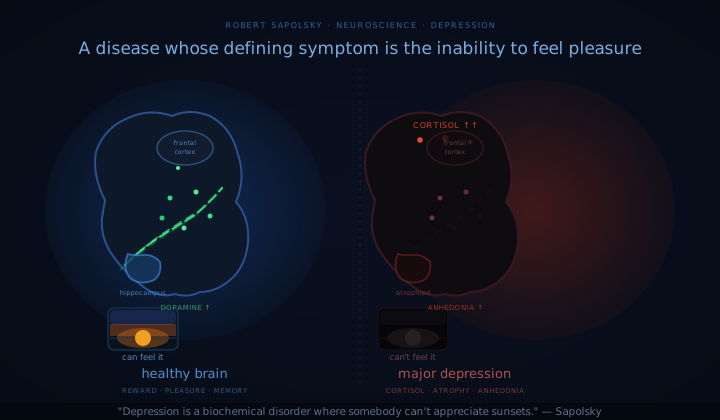
And yet the way we commonly talk about depression — as sadness, as weakness, as a bad few weeks — almost completely misses what is actually happening inside the body. Sapolsky's account is different. "Depression," he says, "is a biochemical disorder with a genetic component and early experience influences, where somebody can't appreciate sunsets."
What anhedonia actually means
The word that unlocks depression is anhedonia — the inability to feel pleasure. Sapolsky calls it the defining symptom. "What could possibly be worse than a disease whose defining symptom is the inability to feel pleasure?"
Normal sadness still contains pleasure. Grief hurts but also holds love. Anxiety is painful but charged with energy. Depression is something else: a flatness, a removal of the reward signal from things that used to work. Food tastes like nothing. Music lands flat. The people you love still exist but you cannot feel what that means.
Sapolsky distinguishes depression from anxiety in terms of what each does to this anhedonic state. "Anxiety is anhedonia in a hyperaroused, vigilant state. Depression is anhedonia without that. Depression is a big old thick blanket that you throw on top of the fire to take the air out of it." Anxiety is alarm with no reward. Depression is silence with no reward. The blanket does not just cover the fire — it smothers it.
The neurochemistry: three systems going wrong
Three neurotransmitter systems each contribute differently to the depressive picture.
Dopamine governs the anticipation of reward — not pleasure itself, but the reaching toward it, the "wanting" that gets you out of bed and toward the things that matter. When the dopamine system is suppressed, the future loses its pull. Nothing seems worth pursuing. This is the neurochemical face of anhedonia.
Norepinephrine drives arousal, motivation, and motor output. When it drops, the body follows: movements slow, thinking slows, getting up feels like pushing through water. Sapolsky calls this psychomotor retardation — the physical heaviness that people with depression describe as a weight that does not lift.
Serotonin modulates mood and, crucially, the tendency to ruminate. Low serotonin does not just flatten mood — it traps thinking in loops. The mind returns obsessively to the same failures, the same fears, the same evidence that things will not improve. Rumination is not a choice. It is the cognitive texture of a serotonin-depleted brain.
The cortisol connection
Underneath the neurotransmitter story is a deeper mechanism: cortisol and the chronic stress response.
In a healthy stress response, cortisol rises to meet a challenge and then falls away. In depression, the stress response does not switch off. The body stays mobilised. "Chronic depression is a picture of a chronic stress response at the hormonal level," Sapolsky says. The hypothalamic-pituitary-adrenal axis — the cortisol-releasing system — runs continuously, as if the threat never passed.
And the costs accumulate. The depressed body is not passive. It is "somebody whose body is blasting through there, over-activated stress response, this enormous battle going on internally" — a system burning itself while the person sits still.
The hippocampus shrinks
One of the most striking things Sapolsky describes is what happens to the brain's structure over time in long-term depression. "People with major long-term depression — their hippocampus gets smaller. Hippocampal atrophy roughly approximating mild dementia."
The hippocampus is central to memory and to learning that something dangerous has passed — it is the part of the brain that should signal the stress system to stand down. Glucocorticoids — cortisol and its relatives — are directly toxic to hippocampal tissue. "You could shrivel up the hippocampal projections, kill neurons, suppress neurogenesis." The stress hormone suppresses the very structure that would normally tell it to stop.
This is what makes long-term depression a self-reinforcing trap. The cortisol damages the hippocampus. A damaged hippocampus cannot suppress cortisol release. Cortisol stays elevated. The hippocampus shrinks further.
How depression learns to sustain itself
Early depressive episodes are typically triggered — a loss, a trauma, a prolonged stressor. But Sapolsky describes what happens after repeated episodes: "Somewhere around the fourth or fifth stress-induced depression, something happens. Things start cycling on their own."
The brain, reshaped by earlier episodes, no longer needs an external trigger. The pattern has been learned at a neural level. Episodes become more frequent, longer, and harder to interrupt. This is why early intervention matters: it is not just about relieving suffering now, but about preventing the circuitry of depression from becoming the brain's default configuration.
Sleep that does not restore
The sleep disturbance in depression is distinctive enough to be diagnostic. It is not primarily trouble falling asleep — it is early waking. People wake at 4 or 5 in the morning, exhausted but unable to return to sleep, their minds immediately active in a direction that is not helpful.
This pattern reflects the dysregulated cortisol rhythm: in depression, the normal cortisol peak that should come just before waking arrives too early, pulling the person out of sleep hours before their body is rested. The morning already feels like a defeat before the day begins.
What this means for how we talk about depression
Sapolsky is unambiguous about the framing. Depression is not a mood. It is not weakness. It is not the result of insufficient effort or insufficient gratitude. It is a biological disorder with identifiable mechanisms — genetic vulnerabilities amplified by early-life adversity, a stress system that cannot switch off, neurotransmitter deficits, and structural brain changes that sustain themselves over time.
The symptom that names it — "a biochemical disorder where somebody can't appreciate sunsets" — is both precise and devastating. It is not that the person lacks the ability to understand that the sunset is beautiful. It is that the signal of beauty does not reach the reward circuit anymore. The lights are on in the world. The receptor is dark.
Understanding this at the biological level is not an argument for fatalism. It is an argument against shame. The body is fighting a real battle. The difficulty in getting up, the inability to feel pleasure, the 4am waking — these are not signs of a broken character. They are signs of a brain whose biochemistry has been pushed beyond what it can self-correct.
That is what treatment is for. And that is why the scale of the undiagnosed — the 80% Sapolsky names — is a public health problem as serious as any other.