Vitiligo: The Immune System Erases the Skin's Color
Vitiligo is the selective destruction of melanocytes — the cells that produce skin pigment — by cytotoxic CD8+ T-cells that recognise melanocyte antigens as foreign. The resulting depigmented patches are a visible record of an ongoing immune assault on a completely harmless cell type.
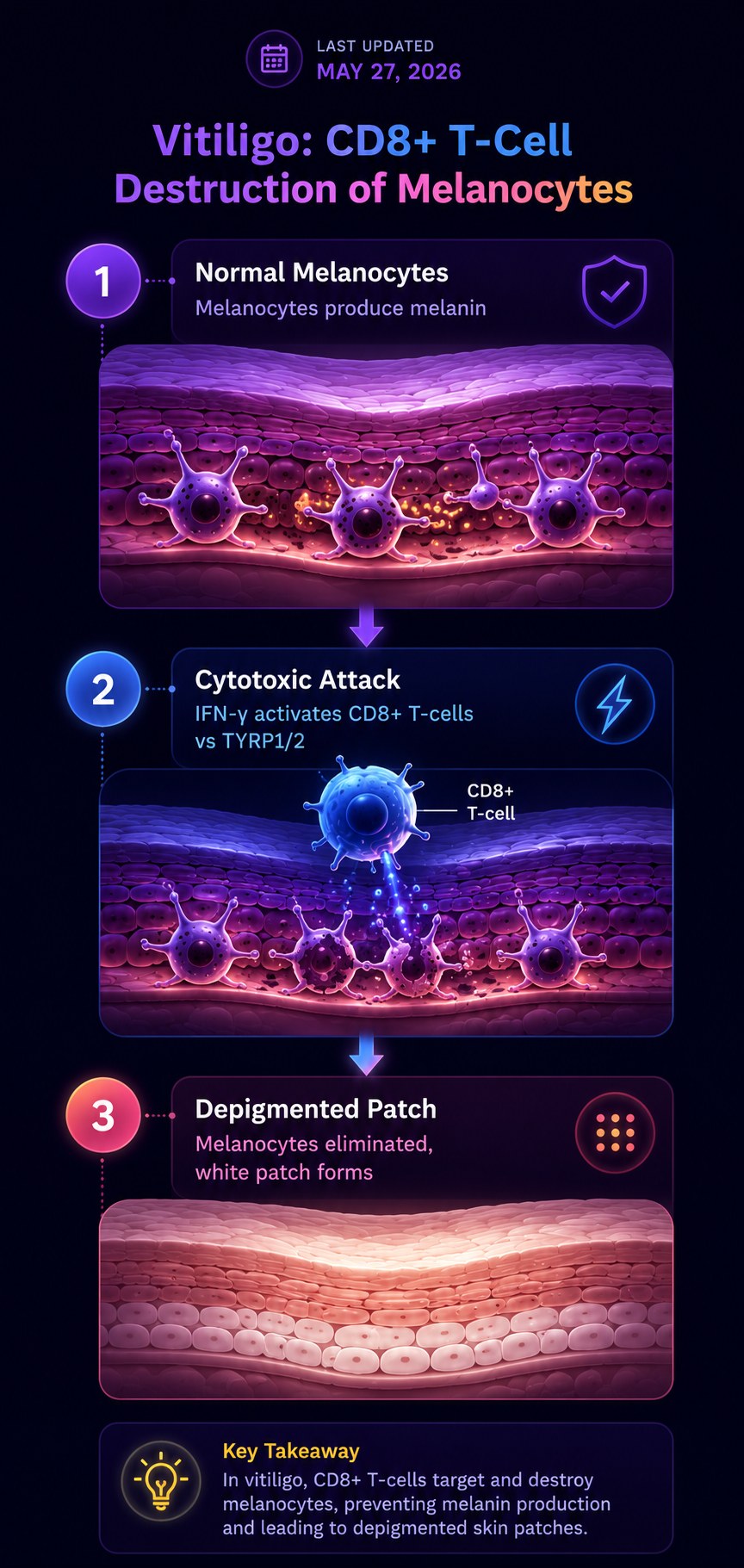
What is happening in the body
Melanocytes are the pigment-producing cells of the skin's basal layer, responsible for synthesising melanin and transferring it to keratinocytes. In vitiligo, CD8+ cytotoxic T-cells recognise melanocyte-specific antigens — particularly tyrosinase, TYRP1, and TYRP2 — and eliminate melanocytes from discrete patches of skin. The T-cells are activated by IFN-gamma signalling and express the CXCR3 receptor, homing to skin in response to the CXCL9 and CXCL10 chemokines produced by keratinocytes under IFN-gamma stimulation.
The autoimmune recognition of melanocyte antigens is thought to begin with cellular stress responses in the melanocytes themselves. Reactive oxygen species (ROS) within melanocytes — particularly elevated in vitiligo lesions — cause protein oxidation and the exposure of neoantigens that activate innate immune signalling via DAMP pathways. Stressed melanocytes upregulate NKG2D ligands on their surface, marking themselves for elimination by NK cells and cytotoxic T-cells. The initial trigger appears to require a systemic immune activation event — consistent with the observation that vitiligo onset frequently follows infection, psychological stress, or chemical exposure.
The symptoms this produces
- Depigmented, chalk-white patches on skin — typically at periorificial areas (around eyes, mouth), dorsal hands, wrists, knees
- Koebner phenomenon: patches appearing at sites of skin injury
- Accelerated depigmentation following sunburn in affected areas
- Premature greying of hair in involved areas
- No pain or physical impairment, but significant psychological impact
- Association with other autoimmune conditions: thyroid disease, type 1 diabetes, Addison's disease
How this fits the autoimmune pattern
The co-occurrence of vitiligo with thyroid autoimmunity, type 1 diabetes, and other organ-specific autoimmune conditions in the same patients and families reveals a shared predisposition to autoimmune tissue destruction driven by common upstream mechanisms. The melanocyte-specific T-cell response requires the same breakdown in peripheral tolerance that drives all autoimmune conditions. The gut, as the site of largest immune activation surface area, is the most likely site of initial tolerance disruption — and the dietary removal of permeability-promoting antigens reduces the systemic IFN-gamma and IL-15 signalling that sustains the melanocyte-directed T-cell response.
What the clinical data shows
Vitiligo is among the more difficult autoimmune conditions to reverse because melanocytes, once destroyed, must be replaced by migration from hair follicle reservoirs — a slow process. Early-stage vitiligo, before complete melanocyte depletion in affected areas, shows the best response to immune intervention. Patients adopting PKD with active vitiligo have reported stabilisation of existing lesions and some repigmentation, particularly in areas with remaining follicular melanocytes. The mechanism is reduction in IFN-gamma-driven CXCL9/CXCL10 chemokine expression that maintains the cytotoxic T-cell homing to skin.
A life with this condition — Stories
Priya, 17. Her mother had vitiligo on her hands; she knew what the patch above her eyebrow was immediately. What she did not expect was the speed — both wrists within six months, patches around both eyes, a streak of white appearing in her dark hair. The patches were painless. That was the strange cruelty of it: an immune assault visible to anyone who looked at her that she felt not at all. Her CD8+ T-cells had identified something in her melanocytes and were eliminating them systematically. Each white patch was a cleared zone, meticulously produced by an immune system that had confused harmless pigment-makers for a threat that did not exist.
James, 29. His vitiligo appeared within two months of the most stressful period of his life — a business collapse, a relationship ending, six weeks of almost no sleep. He had read that psychological stress could trigger autoimmune conditions but had always found that idea vague and unscientific until depigmented patches appeared on both hands and wrists, places where stress-induced cortisol dysregulation is thought to lower the threshold for melanocyte-directed immune activation. His dermatologist said the timing was consistent. The patches were permanent. The stress had passed. The record of it remained on his skin.
Fatima, 42. Her vitiligo was confined to one side of her face — the segmental pattern, which follows a dermatomal distribution and behaves differently from the generalised form. It is faster to spread initially but then typically stops, unlike generalised vitiligo which can continue expanding for life. What her dermatologist found on routine workup was more concerning than the skin: her TSH was elevated and her anti-TPO antibodies were 480 IU/mL. She had Hashimoto's thyroiditis alongside her vitiligo — two autoimmune conditions targeting two different cell types, driven by the same underlying immune terrain. She had come in for her skin and left with a second diagnosis.
Transcript witness — Dr. Shawn Baker podcast. Dr. Shawn Baker, physician: "My vitiligo has improved on a carnivore diet. Joe Rogan commented that he has vitiligo and it is getting better on carnivore as well. The removal of inflammatory foods probably removes the IFN-gamma signalling that maintains the cytotoxic T-cell homing to skin. I have seen a lot of vitiligo improve on a carnivore diet now — not always dramatically, but stabilisation of existing lesions and in some cases genuine repigmentation. This is not something the dermatology literature is studying, because there is no drug to trial. But people are noticing."
Transcript witness — zerocarb community. A person with vitiligo and ADHD describing their carnivore experience: "I also have an autoimmune disorder — it is called vitiligo. And my vitiligo improved. I lost all my belly fat, my energy levels were completely flat — no ups and downs. And the vitiligo. The spots are smaller. I do not know how to explain it scientifically, but they are smaller. The doctors have told me for years that vitiligo cannot reverse. I am showing them a photograph."
Kofi, 25. His vitiligo started on his hands and spread to his forearms within a year. His dermatologist offered narrowband UVB phototherapy — a treatment that stimulates melanocyte stem cells in hair follicles to migrate and repigment the skin. He completed 36 sessions. Repigmentation appeared as small islands of colour within the depigmented patches — perifollicular repigmentation, his dermatologist called it. The treatment worked, slowly. It required continued sessions to maintain. He understood that the phototherapy was addressing the visible disease — the empty skin — rather than the immune process that had created it. Stopping treatment meant the process would continue.
Amelia, 33. Her vitiligo was symmetrical and rapidly progressive — both forearms, both shins, the perioral area, both eyelids — over eighteen months. Her dermatologist started dupilumab, which targets the IL-4/IL-13 pathway. The progression slowed, then stopped. Dupilumab had not been developed for vitiligo; it was approved for eczema and asthma. Her dermatologist was using it off-label based on the shared cytokine signalling between vitiligo and atopic conditions. It worked for her. Whether it would have worked had the IL-13 pathway not been her particular inflammatory driver was a question nobody could answer in advance.
Bernard, 48. His vitiligo appeared in the six months following the death of his wife — a period of bereavement-related immune dysregulation that he later read was a documented trigger for vitiligo onset. He was a GP himself and understood the mechanism intellectually: cortisol-driven shifts in regulatory T-cell function, increased IFN-gamma, the conditions that allow autoreactive cytotoxic T-cells to target melanocytes. Understanding the biology had not given him any tools to prevent it. He watched the white patches appear on his hands and face and did what his patients did — he waited, he researched, and he tried to decide what to do with information the medical system had not organised into a treatment plan.