The Timid Person: What Jordan Peterson Says About Shrinking from the World
Peterson has a confronting message for people who think of themselves as gentle, non-confrontational, or too kind to push back: that is not virtue. That is cowardice dressed up as niceness. His argument — drawn from evolutionary biology, clinical psychology, and decades watching people ruin their lives through passivity — is that the world needs you to be formidable, not harmless.
Most people who are timid do not think of themselves that way. They think of themselves as kind. Considerate. Non-confrontational. They pick their battles. They don't want to make waves. They are, they believe, being the better person by staying quiet, by going along, by not making a fuss.
Jordan Peterson disagrees. Strongly.
His argument — built from evolutionary biology, clinical psychology, and thirty years watching people destroy their own lives — is that what we call "being nice" is often something else entirely. And that the failure to confront it directly is one of the most common and most damaging mistakes a person can make.
The lobster you probably didn't expect
Peterson opens his first rule with lobsters, which sounds absurd until you understand why.
Lobsters have been around for 350 million years. They live in hierarchies — dominant lobsters get the best territory, the best food, the best mates. Submissive lobsters get what's left. And here is the part that matters: the lobster's nervous system knows which one it is, and it adjusts the body accordingly.
A dominant lobster stands tall, moves confidently, takes up space. Its serotonin levels are high. A defeated lobster hunches, flinches, shrinks into corners. Its serotonin levels are low. Antidepressants work on lobsters. The same basic neurological machinery that runs in you has been running in these creatures for hundreds of millions of years.
When you hunch your shoulders, drop your gaze, make yourself small — your nervous system reads that posture and responds. It lowers your serotonin. It raises your stress hormones. It tells the ancient circuitry in your brain: you are low-status, you are threatened, you should hide.
This is Rule 1 of Peterson's Twelve Rules: stand up straight with your shoulders back. Not because of appearances. Because the posture is not just a signal to others — it is a signal to yourself. And your body believes it.
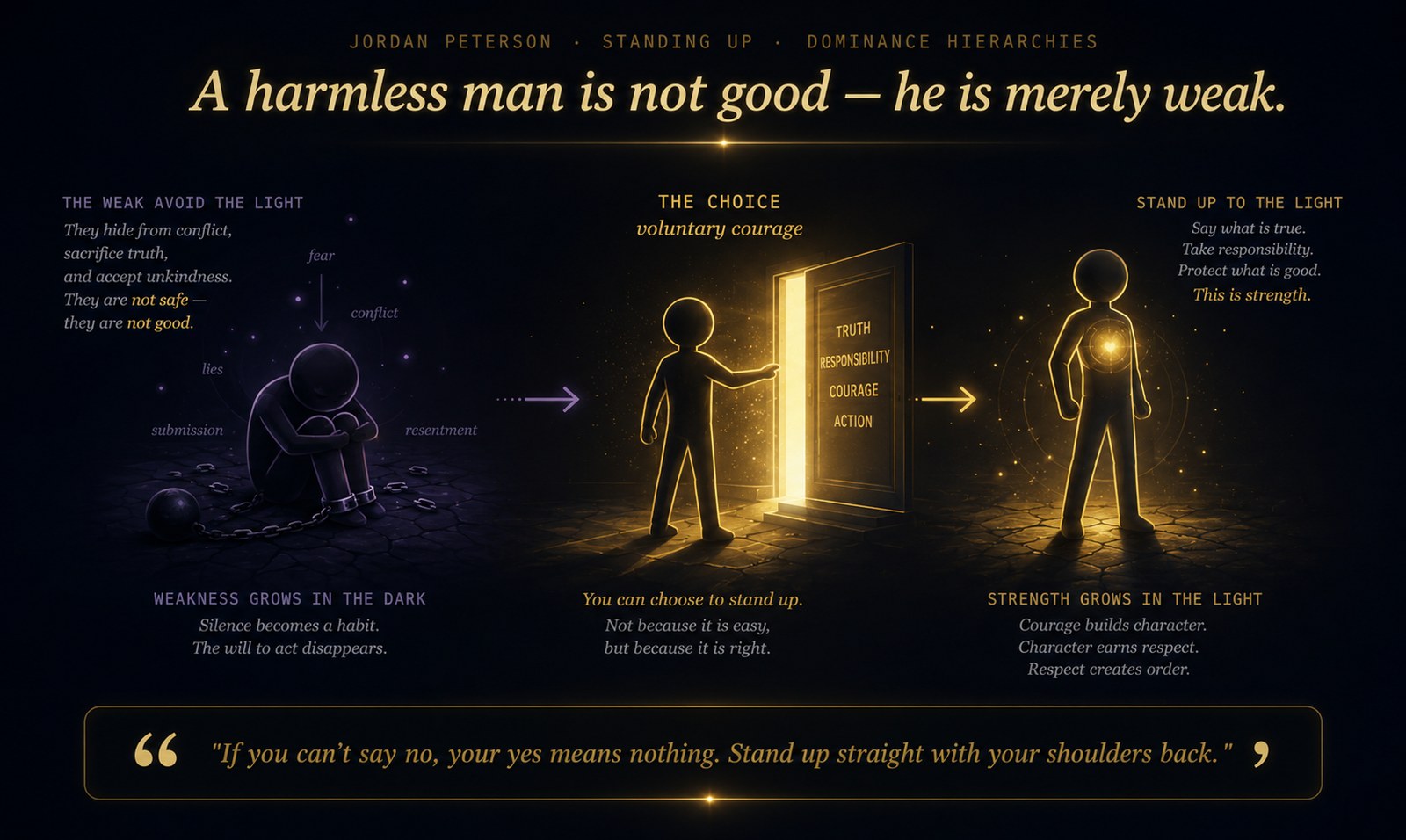
A harmless man is not a good man
Here is the line Peterson returns to repeatedly, the one that hits people hardest:
"A harmless man is not a good man. He is merely a weak one."
This distinction is central to everything else he says about timidity. Most gentle, non-confrontational people believe their gentleness is a moral quality — evidence of their goodness. Peterson says no. Gentleness that comes from genuine strength, from choosing not to harm when you could, from voluntary restraint — that is a virtue. Gentleness that comes from fear, from the inability to push back, from not wanting to deal with the discomfort of conflict — that is not a virtue. It is a failure dressed up as one.
The person who cannot say no is not kind. They are incapable. The person who never challenges anyone is not peaceful. They are afraid. These are not the same things, and treating them as the same is a mistake with real consequences.
What happens when you can't say no
Peterson's clinical observation, repeated across thousands of hours in the therapy room, is this: people who cannot say no tend to accumulate resentment at a rate that eventually becomes dangerous.
It works like this. You agree to something you didn't want to agree to. You don't say how you actually feel. You help when you didn't want to help, stay quiet when you had something important to say, let someone treat you in a way you found unacceptable. Each individual instance feels like the kind thing to do — avoid the conflict, keep the peace, don't be difficult.
But the body keeps score. The resentment builds. And resentment that has nowhere to go tends to come out eventually — as passive aggression, as sudden disproportionate explosions, as a slow withdrawal from the people and situations you've been silently tolerating. The "kind" person who never pushes back very often becomes, over time, either a doormat or a volcano.
"If you cannot say no, your yes means nothing."
A yes that comes from genuine choice — from someone who could have said no and chose not to — is meaningful. A yes from someone who has no no available is just compliance. The person who gives that yes knows the difference, even if they can't articulate it. And so does everyone around them.
How timidity enables the worst in others
There is a harder point Peterson makes, one that people who think of themselves as gentle often resist. When you refuse to push back, you are not just harming yourself. You are enabling the people around you to be worse than they would otherwise be.
When you allow someone to treat you badly, you are providing an environment in which that behaviour is acceptable. You are, in a real sense, helping create the version of that person who gets away with it. The person who lies to you and gets no response learns that lying works. The person who dismisses you and faces no pushback learns that dismissal is fine. Your silence is not neutral. It is, functionally, permission.
Peterson is blunt about this in his clinical work: the person who presents themselves as a victim of other people's bad behaviour very often has a role in maintaining that behaviour. Not through active participation, but through the failure to say, clearly and directly: this is not acceptable. That is not a comfortable thing to hear. It is also, in Peterson's view, the beginning of getting out.
The dragon that grows while you sleep
One of Peterson's most vivid metaphors for the cost of avoidance is the dragon. The things you avoid do not go away. They grow.
The conversation you keep putting off. The boundary you keep not drawing. The truth you keep not telling. The challenge you keep not taking on. Each time you avoid it, it gets a little bigger. Each avoidance makes the next confrontation feel even more impossible. The person who avoids one difficult conversation ends up eventually facing a catastrophic one — because the small thing they couldn't handle became a large thing over the years they were looking away.
This is one of Peterson's core clinical insights: anxiety, properly understood, is not about the present threat. It is about all the avoided threats that have accumulated, all the problems that were put off instead of faced, all the dragons that were allowed to grow. The person who is chronically anxious is often, underneath the anxiety, a person who has been avoiding their life for years.
The solution is not to relax. It is to start fighting the dragon while it is still small — to say the thing, draw the line, take the challenge, before it becomes unmanageable.
Agreeableness — a good thing, badly placed
Peterson draws on the Big Five personality model here, and specifically on the trait of Agreeableness — the tendency to be cooperative, considerate, empathetic, easy to get along with. High agreeableness is genuinely valuable. It makes people pleasant to be around, cooperative to work with, sensitive to the needs of others.
But high agreeableness combined with the inability to assert oneself is a problem. And it is a problem that skews female — women score higher on agreeableness on average than men, and Peterson notes that many of the patterns he sees in clinical practice around excessive compliance, inability to say no, and accumulated resentment are more common in women than men.
The issue is that agreeableness, taken too far, functions as a disguise for conflict avoidance. The agreeable person believes they are being kind. Often they are being afraid, and calling it kindness because that is a more comfortable story. The growth edge for a highly agreeable person is not to become disagreeable. It is to become capable of disagreement — to be able to say no when no is the honest answer, to push back when pushback is warranted, while retaining the genuine warmth that makes agreeableness a virtue.
The difference between peace and passivity
Peterson makes a distinction that people who struggle with timidity often find clarifying: there is a difference between choosing peace and defaulting to passivity. They look identical from the outside. They feel very different from the inside, and they have very different consequences.
The person who chooses peace — who genuinely evaluates a situation and decides that the best response is to let it go — has made an active decision. They have the capacity to respond differently and are exercising voluntary restraint. The person who defaults to passivity has not made a decision. They have avoided making one.
The test is simple: could you push back if you chose to? If you genuinely could, and you are genuinely choosing not to, that is equanimity — a real virtue. If the honest answer is that you could not push back, that the thought of it fills you with dread, that you don't have access to your own no — that is not peace. That is avoidance, and it is costing you.
Why speaking up is a moral obligation
Peterson's most challenging claim in this area is that speaking up — saying what you actually think, even when it is uncomfortable, even when it risks conflict — is not just good for you personally. It is a moral obligation.
His reasoning: you have a perspective that is yours alone. You have seen things, experienced things, thought about things in a way that no one else has. When you withhold that perspective — when you stay quiet to keep the peace, when you say what you think people want to hear rather than what you actually believe — you are depriving the conversation, and the people around you, of something real.
"The most dangerous people in the world are not the cruel ones. They are the weak ones who enable cruelty through their silence and their compliance."
A world in which people say what they actually think is a world that can self-correct. Bad ideas get challenged. Bad behaviour gets called out. The feedback loop that allows a community, a relationship, an institution to function properly requires honest speech. When timidity silences honest speech — when people stay quiet because it is easier, because they are afraid, because they want to be liked — the system loses the corrective mechanism it needs.
What standing up actually looks like
Peterson is clear that what he is advocating is not aggression, not dominance, not the performance of confidence. It is something more specific and more difficult: voluntary engagement with the difficulty of the world, from a place of genuine strength.
The upright posture of Rule 1 is a symbol of this. Not puffed-up, not aggressive — but open, present, meeting the world with your full height rather than trying to make yourself small enough that nothing bad will notice you. The person who stands up straight has decided, at some level, to be present in the world rather than to hide from it.
Speaking honestly when you have something honest to say. Drawing a boundary when a boundary is warranted. Taking on the challenge that frightens you, rather than finding reasons why you are uniquely unsuited to face it. These are the small, daily acts that build the thing Peterson is actually advocating — not confidence as a mood, but competence as a fact, accumulated through repeated engagement with difficulty.
The kindness that is actually kind
There is a version of the message here that sounds harsh, and some people stop at that version: Peterson is telling timid people that their gentleness is a weakness. That they should be tougher, more aggressive, more dominant.
But that is not the full picture. The full picture is this: genuine kindness — the kindness that actually helps people, that makes real relationships possible, that can sustain someone through hard things — requires a self strong enough to give it. You cannot genuinely care for someone from a place of fear. You cannot really say yes to someone if you have no access to your own no. You cannot be truly generous from a position of resentment.
The person who learns to stand up — who develops the capacity to push back, to say no, to engage honestly with the difficulty of other people and the world — does not become less kind. They become capable of a kind of kindness that was not available to them before. The kindness of genuine choice rather than fearful compliance. The warmth of someone who is fully present, rather than someone who has made themselves small enough to be invisible.
That is what Peterson is pointing toward. Not the monster on a chain — not cruelty disguised as strength — but the person who has claimed their full height, who has faced the dragons that were growing in the corners of their life, and who can now meet the world with their shoulders back and their eyes open.
Stand up straight. It is the beginning of everything else.