Stop Lying to Yourself: Peterson on the Small Lies That Make You Sick
Not the dramatic lies — the small ones. The agreement nodded to without belief, the opinion voiced to fit the room, the grievance withheld to keep the peace. Peterson's most-repeated instruction, what he says these lies do to the person who tells them, and what he says is the way back.
Jordan Peterson has said many things in his public career, some prophetic and some controversial, but if there is one practical instruction he returns to more often than any other, it is this: stop lying to yourself. Not "discover your authentic self," which is vaguer and more comfortable. Not "pursue the truth," which he admits you probably do not fully know. The instruction is behavioural and uncomfortable: stop saying things you know are false. He frames this not as a metaphysical claim about capital-T Truth but as a discipline of small corrections, a practice of noticing when your mouth is producing sentences your conscience has already rejected. This essay traces what Peterson means by lies, what he says they do to the person who tells them, why people persist in telling them anyway, and what he believes is the way back.
The lies he actually means
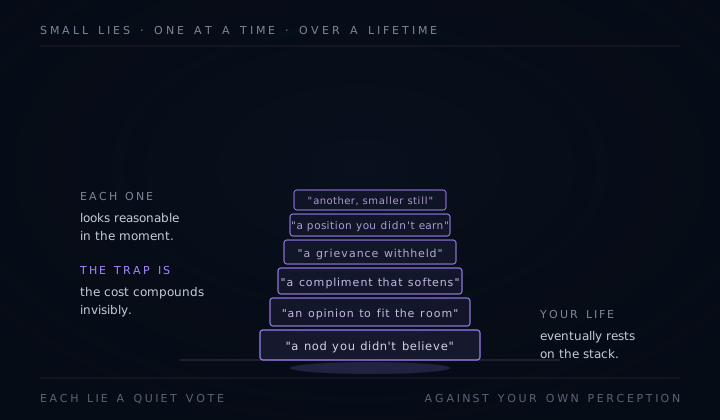
Peterson is not talking about the headline lies, the frauds that land people in court or end marriages. He means the small ones. The agreeable nod when someone says something you know is wrong. The opinion you voice because it fits the room and you are tired of being the exception. The compliment offered not because you mean it but because it smooths over a difficult moment. The grievance you swallow because raising it would require an argument you do not want to have. The position you accept at work or in a relationship because resisting it costs more than you can afford right now. The conviction you express to people who would punish you for the real one. His point, repeated across years of lectures and interviews, is that it is not the dramatic betrayals that corrupt a life; it is the steady accumulation of small false sentences, each one known to be untrue at the moment it leaves your mouth. These are the lies that matter because they happen every day, in settings so ordinary that you stop noticing them, and because the person you are lying to most consistently is yourself.
What lying does to you
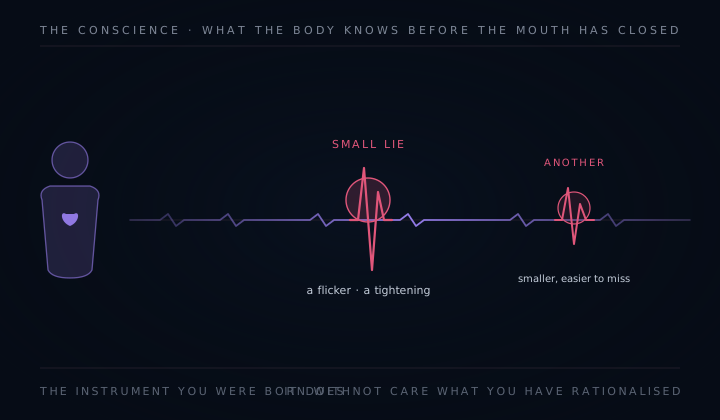
The mechanism, in Peterson's telling, is cumulative and structural. Each small lie is a quiet vote against your own perception. You notice something is wrong; you say it is fine. You prefer one option; you agree to another. You believe X; you nod along with Y. After enough repetitions of this pattern, you can no longer trust the instrument by which you read the world, which is yourself. He talks about this in terms of conscience: the body knows when something is false even when the mind is already constructing justifications for it. The felt sense of wrongness—the tightening in the chest, the small reluctance, the flicker of discomfort—is the warning signal. Ignoring it does not make it go away; it teaches you to ignore your own signals. Over time, the person becomes unreliable to themselves. They can no longer say with confidence which of their preferences are real and which are accumulated performances. They drift further from the life they would have led if they had been paying attention. The damage looks accidental from the outside, like a series of unfortunate events, but Peterson insists it is structural. The foundation has been rotting for years, one small false sentence at a time.
The conscience as instrument
Peterson's claim here is somatic, not merely philosophical. Your body registers a lie before the conversation has finished. A flicker of unease, a tightening somewhere you would rather not notice, a small reluctance you immediately suppress. He frames this not as moralism but as evidence of an internal compass that has been functioning for a very long time and does not particularly care what you have rationalised. The body's signal precedes conscious justification; it arrives before you have finished explaining to yourself why the false sentence was necessary or harmless. He points out that the people who report the loudest moral confidence, who are most certain of their righteousness, are often the people who have most aggressively overridden this signal. They have spent years training themselves not to feel the warning. The instrument can be silenced, but it cannot be argued with. It continues to register the discrepancy between what you know and what you say, and the cost of ignoring it accumulates whether you acknowledge it or not.
Solzhenitsyn and the political dimension
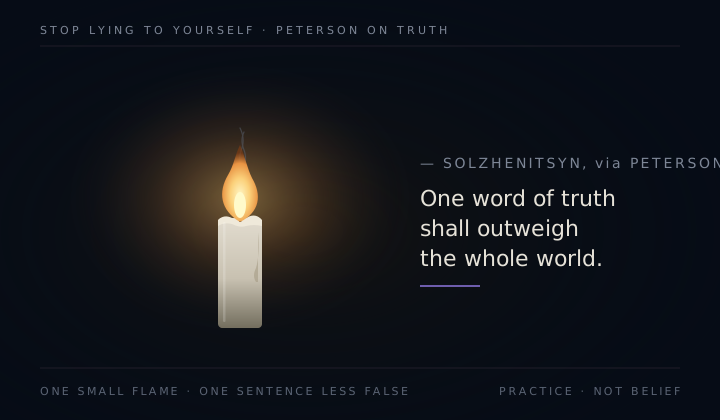
Peterson's most-cited line on this question comes from Aleksandr Solzhenitsyn: live not by lies. The political claim Peterson draws from Solzhenitsyn is that large-scale catastrophes are not first built by villains; they are built by ordinary people who let small lies pass. In their workplaces, at their dinner tables, in rooms where speaking up would cost them something they are not prepared to lose. The Gulag, in Peterson's reading, was made possible not primarily by Stalin's malevolence but by millions of withheld objections, by people who knew something was wrong and said nothing, or who said the opposite of what they knew. This is why the private practice of not lying is, for Peterson, the most political act available to an individual. It is not that telling the truth in your own life will prevent tyranny by itself; it is that tyranny becomes possible when enough people have abandoned the practice of noticing and naming what is false. The totalitarian state depends on a population that has already surrendered its relationship to truth in small, daily transactions. Solzhenitsyn's instruction—and Peterson's—is to refuse that bargain, starting with the next sentence you are about to say.
Why people lie to themselves
Peterson's psychological reading is straightforward: the lie is almost always cheaper in the moment than the truth. The truth might cost you a friendship, a job, a comfortable image of yourself, or simply the peace of the next hour. The lie buys you that peace. The trade looks reasonable each time, and that is the trap. The cost compounds invisibly, and the person who pays it never sees the invoice until they no longer recognise their own life. He talks about people who keep finding themselves in situations they did not choose, who cannot say what they actually want, who feel resentful for reasons they cannot name. His diagnosis is consistent: they have traded the immediate discomfort of truth for the long-term disintegration of self. The lie was easier a thousand times, and now they do not know who they are. The bill arrives all at once, years later, in the form of a life that does not feel like theirs.
The honest sentence, not the maximal one
The nuance that often gets missed in Peterson's instruction is this: he is not recommending maximally honest speech. The maximally honest sentence is often cruel and almost always foolish. Saying everything you think, with no filter, is not integrity; it is narcissism or stupidity. The instruction is narrower and more practical: find a sentence that is less false than the one you were about to say. The next sentence does not have to be the truest one available to human language; it just has to not be a lie. He says this distinction matters because the impossible standard—full honesty about everything, all the time—is what people use to excuse themselves from the practical one. They tell themselves that since they cannot be perfectly truthful, there is no point in being slightly more truthful than they were yesterday. Peterson's instruction cuts through that rationalisation. This single sentence, right now, that you know is false: find a version that is less so. Start there.
What he tells people to do
The practical instruction is simple and uncomfortable. Start small: notice the next time you are about to say something you know is not true, and try to find a phrasing that is less false. Pay attention to the body, because the body will tell you when a sentence is wrong before your mouth has closed. When you cannot say something truthfully, say less. Silence is often more honest than a false sentence. Write down the things you actually believe, in private, so that the act of forming them in language is not foreign when the moment to speak them arrives. Watch which beliefs you have been holding for someone else's benefit—your parents', your employer's, your friends'—and ask whether you still believe them when no one is watching. Peterson recommends doing this slowly and accepting that almost no one does it well. The practice is uncomfortable because it costs you things: approval, peace, the image you have been maintaining. It is also, he insists, the only practice that actually changes anything. Everything else is performance.
What truth-telling builds
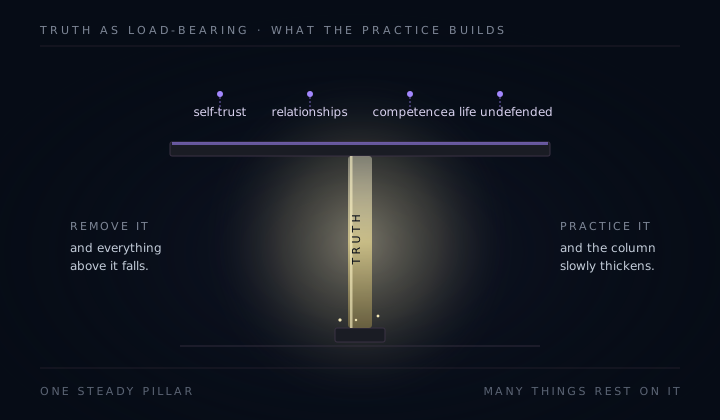
The reward, in Peterson's telling, is not moral superiority or spiritual enlightenment. It is operational competence. The person who tells the truth, even haltingly, slowly becomes able to trust themselves. The instrument re-calibrates. You say what you mean, you notice what happens, and the feedback loop starts to function again. Relationships realign around what is actually there, rather than around the performance you have been maintaining. Work that had been a careful performance becomes simpler, because performance is exhausting and accuracy is not. He talks about this as a recovery of competence—not of moral status, but of basic reliability. The world becomes more predictable to a person who is no longer the source of most of the noise in it. Their decisions improve, because the information they are operating on improves. The people around them feel safer, because the signals they receive are real. Peterson frames this not as virtue but as function: a truthful person is a functional person, and a functional person can actually build something.
The price of the practice
Peterson is candid about the cost. The person who starts telling the truth pays for it. Some friendships end, because they were built on a version of you that no longer exists. Some jobs become untenable, because they required you to say things you do not believe. A version of yourself you had carefully assembled, the one that fit into rooms and made people comfortable, has to be dismantled. This is not a small thing. People lose relationships, income, and social standing when they stop performing. Peterson does not pretend otherwise. He says the practice is genuinely costly and that pretending it is not is itself a lie. But the cost is finite. The cost of continuing the alternative—of spending your entire life saying things you know are false—is not. That cost grows until it consumes you.
The instruction is small. The practice is slow. The reward is the only one Peterson reliably promises: a life that does not, in the long run, have to be defended.