What You Push Down Grows in the Dark: Peterson on Why Repressing Feelings Makes Them Stronger
Peterson teaches that suppressed emotions do not disappear — they build pressure, grow stronger in the dark, and eventually surface in ways that are harder to control. The answer is not to be controlled by your feelings, but to face them: integrate the shadow, pay attention to resentment as a signal, and face what you are avoiding before it faces you.
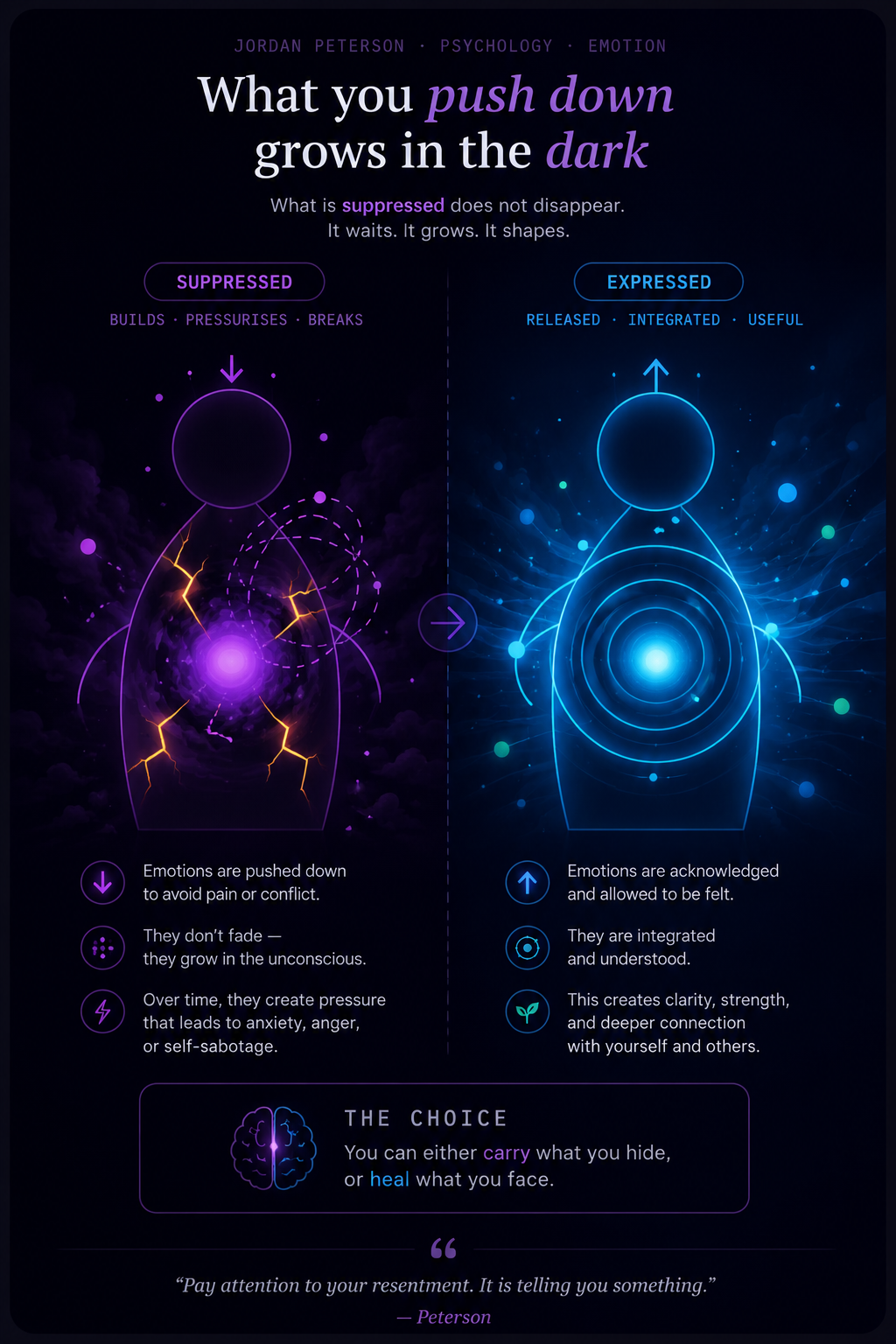
The obvious strategy when something painful, frightening, or dark surfaces inside you is to push it down. Don't feel it. Don't look at it. Keep it under control. Peterson's consistent message is that this strategy does the opposite of what it promises: what you suppress does not weaken. It grows. And it grows in a direction you cannot see until it is too large to manage.
The biology of avoidance
Peterson describes what happens at a physiological level when you run from something instead of facing it. "If you're facing a challenge and you don't want it, and you reject it and you're afraid and you're running — then the genes that turn on inside you are going to turn you into a prey animal and something that's hiding."
This is not a metaphor. The body's threat-response system is shaped by whether you habitually approach difficulty or retreat from it. "But if you face that voluntarily, then that puts you in an entirely different psychophysiological state. The data on this are quite clear — and that's going to craft you into the sort of person who's more and more able to voluntarily confront larger and larger challenges."
Avoidance does not neutralise the threat. It trains your system to treat threats as unmanageable — and then trains you to make yourself smaller in response to them.
Resentment is not a problem — it is a signal
One of the most practical things Peterson says about suppressed emotion is this: "Pay attention to your resentment. Determine whether that's you or the situation. Sort out the issue."
Resentment is often treated as something shameful to be hidden — either from others or from yourself. Peterson treats it as information. If you feel persistently resentful in a relationship, a job, or a role, that feeling is telling you something specific: either you are not standing up for yourself, or too much is being asked of you, or something about the arrangement is genuinely wrong.
"If you notice that you're irritable and resentful, you want to determine whether you're just being irresponsible and immature — or whether you're demanding too much of yourself. That's a very hard thing to sort out, but really necessary."
Suppressing resentment does not resolve the underlying issue. It accumulates. Peterson is direct about where that accumulation leads: Cain, in the biblical account, responds to the failure of his offerings not by learning and adjusting, but by turning the resentment inward and outward simultaneously. "Cain in killing Abel — in consequence of resentment — which is not the only way to respond to the failure of Cain's life. He chooses that." God's accusation is that Cain invited the destructive impulse in, rather than dealing with what the rejection was actually telling him.
The resentment that is never addressed does not stay small. It grows into something with a destructive life of its own.
The shadow — what you refuse to look at controls you
Peterson draws heavily on Jung's concept of the shadow: the parts of yourself you have decided are unacceptable, dangerous, or wrong — and have therefore pushed out of conscious view. The problem is not that you pushed them down. The problem is that they don't stay down. They operate unconsciously, which means they operate without your oversight.
He makes this point through stories. The Hobbit — Bilbo Baggins — is a comfort-seeking, timid creature who has suppressed the part of himself capable of courage, theft, and risk. "You never know when you might need the darker sides of your character integrated within you in a manner that doesn't terrify you, in order to take the next step forward."
"If you're not a bit of a monster, and you encounter a monster, you're going to lose. So you need to have some of the monster within you."
Harry Potter carries a piece of Voldemort's soul — not by choice, but because it was placed there. Peterson sees this as psychologically accurate: the child who has integrated some darkness is more capable of recognising and resisting it in the world than the child who has been protected from ever encountering it. "You can call on the part of you that has the capacity for mayhem to protect you and those you love when mayhem comes threatening."
The shadow is not supposed to run free. It is supposed to be integrated — known, contained, and available when needed. The person who has never acknowledged their capacity for anger, cruelty, or darkness has not eliminated those capacities. They have simply made them invisible to themselves, which is not safer. It is more dangerous.
Being too agreeable is a form of repression
Peterson connects emotional suppression directly to agreeableness. People who are very agreeable — who find it deeply uncomfortable to assert themselves, disagree, or cause friction — often suppress their real reactions habitually. They say yes when they mean no. They don't voice the resentment they feel. They swallow the frustration.
"If you're too agreeable and you sacrifice others, you can dispense with your resentment and learn to stand up for yourself." But first you have to stop suppressing the signal that something needs addressing.
"There are narcissists who are selfish, and there are agreeable people who are like reverse narcissists — everyone else comes first. Taking advantage of yourself counterproductively and becoming bitter and resentful in the service of others — that is not a moral accomplishment."
The person who never says what they actually think accumulates a version of resentment that eventually demands expression. The longer the suppression goes on, the less control they have over how it comes out.
What facing it actually looks like
Peterson describes what he consistently hears from people who begin to take this seriously. "Young people in particular come to me and say: 'Look, I've been trying to take on more responsibility and to face the things I've been avoiding — and everything is way better.'"
The process is not pleasant. Facing what you have been avoiding — the difficult conversation, the genuine feeling, the dark part of yourself — is uncomfortable. But the discomfort of facing it directly is bounded. The discomfort of continued suppression is not bounded. It grows.
"The basic challenge of your life, in some real sense, is to not allow the weight of your mortal vulnerability to embitter you and drag you into hell. I think that's even a more pertinent threat than death. You better be set up for the challenge."
You are only truly good if you chose it
There is a deeper point underneath all of this that Peterson returns to: a person who has never faced their own capacity for darkness, who has only ever been "harmless," is not the same as a person who has integrated that capacity and chosen not to act on it.
The harmless person is fragile — they have no idea what they are capable of under genuine pressure, and they have no access to the strength that comes from knowing you could harm and choosing not to. "You need to have some of the monster within you." Not to use it destructively — but to have it available, tamed and directed, for the moments when it is the only thing that will serve.
The suppressed emotion, the denied anger, the unacknowledged darkness — these do not make you safer or better. They make you less whole. And a less whole person is not more virtuous. They are simply less honest about what is there — and eventually, more likely to be overwhelmed by it.