Why Jordan Peterson Thinks Dostoevsky Is the Greatest Fiction Writer Who Ever Lived
Peterson rates Dostoevsky above every other fiction writer he has read — head and shoulders above the rest. The reason is not stylistic. It is that Dostoevsky dealt with the hardest questions human beings face, put the strongest possible arguments on every side, and saw — a generation before it happened — exactly what the death of God would produce in the modern world.
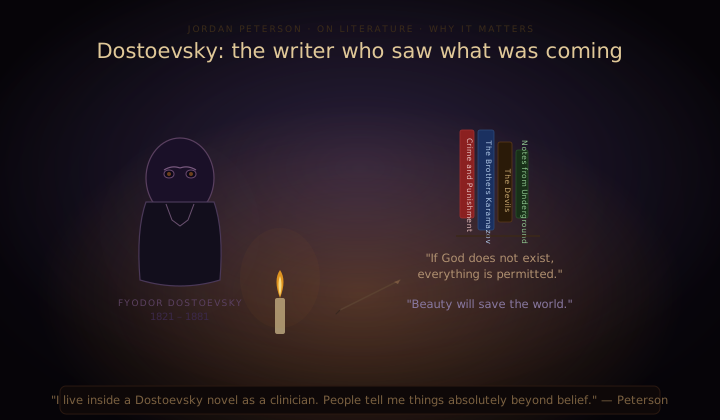
Jordan Peterson has read widely — Jung, Nietzsche, Solzhenitsyn, Milton, the Bible. He teaches, lectures, and has spent three decades in the clinical trenches listening to people describe their lives. When he names the one fiction writer who towers above all others, it is not Shakespeare, not Tolstoy. It is Fyodor Dostoevsky.
"He's head and shoulders above anyone I've ever read in terms of writers of fiction," Peterson said in one of his lectures. "He deals with the hardest questions that human beings face."
This is not a literary opinion. It is a claim about what Dostoevsky understood about human nature — and why that understanding is more urgently needed now than ever.
What Dostoevsky actually did that others don't
Most writers, when they tackle big philosophical questions, stack the deck. The character who represents the author's view gets the best arguments. The opposition is a strawman. You finish the book knowing whose side you were supposed to be on.
Dostoevsky does not do this. Peterson is explicit about it: "He has characters on both sides of the argument and they really lay out the arguments. It's not like Dostoevsky took the easy way out."
The atheist characters in Dostoevsky are not stupid. They are passionate, brilliant, morally serious people with arguments that are genuinely hard to answer. The believers are not simple. They struggle. Peterson describes Ivan Karamazov — the atheist brother in The Brothers Karamazov — as "my favourite atheist. He's passionate, he's committed, he's moral. He's a moral atheist, not an amoral atheist. He's admirable, and charismatic."
And then Dostoevsky makes Ivan's argument as powerful as possible — and still shows why it isn't enough.
This is what Peterson means when he compares Dostoevsky to Nietzsche. "Everything in Nietzsche is in Dostoevsky and more," he says. "Nietzsche abstracted out all these philosophical principles. Dostoevsky extracted out almost exactly the same principles, but they were all embodied in characters."
Nietzsche gives you the idea. Dostoevsky gives you the idea walking around in a person, making decisions, suffering consequences. You don't just understand it intellectually. You experience it. And Nietzsche himself, Peterson notes, knew this — he had deep respect for Dostoevsky's imagination.
The Grand Inquisitor — the greatest argument against God ever written
The centrepiece of The Brothers Karamazov — the passage Peterson returns to most often — is a chapter called The Grand Inquisitor. Ivan tells his brother Alyosha a story.
Christ returns to earth during the Spanish Inquisition. He performs miracles. The people recognise him. The Cardinal — the Grand Inquisitor — has him arrested and comes to his cell at night to tell him, quietly, that he will be burned the next day. And then the Inquisitor explains why.
The argument is this: Christ gave people freedom. But freedom is an unbearable burden. People don't want to be free — they want bread, certainty, and someone to tell them what to do. The Church took the freedom Christ offered and converted it into security and order. The Church serves people better than Christ did, because the Church understood what people actually need. Christ, by contrast, asked too much.
It is, Peterson says, one of the most powerful arguments against Christianity — and against the idea of human freedom — ever mounted. And it is made by a character in a novel written by a Christian. That is the level Dostoevsky operated at: he could write the prosecution's case better than the prosecution could.
Peterson connects this to his own clinical work. He has sat across from thousands of people who have, in various ways, chosen security over freedom — who have traded their honesty, their responsibility, their difficult choices for comfort and compliance. The Grand Inquisitor is not just theology. It is a description of a temptation that is absolutely real, and that most people partially succumb to.
Crime and Punishment — the definitive study of "if there is no God, all is permitted"
Nietzsche's declaration that God is dead carries an obvious implication: if there is no God, there is no absolute moral authority. If there is no absolute moral authority, why not make your own rules? Why not, if you are brilliant enough and your cause is just enough, step outside ordinary moral constraints?
Raskolnikov, the protagonist of Crime and Punishment, decides to test this idea. He convinces himself — with genuinely sophisticated reasoning — that he is one of the exceptional people, the kind who are above ordinary morality, and that he can commit the perfect murder of a pawnbroker he regards as a parasite, using her money to do good in the world.
He commits the murder. It is perfect. He is not caught. And then the book happens.
"You try breaking a moral rule," Peterson says, "especially one of your own. And then try convincing yourself that it's okay. Good luck with that. You break a moral rule that's sufficiently deep, you'll traumatize yourself, and there's no getting around it."
Raskolnikov discovers that there is something in the structure of a human being that cannot be reasoned around. The intellectual justification that seemed so solid collapses under the weight of what he has actually done. He is not caught by the police. He is caught by his own conscience — by something deeper than argument, deeper than philosophy, that refuses to accept what his reasoning told him was acceptable.
This is Dostoevsky's answer to the question: can you simply decide to be beyond good and evil? No. Not because God will punish you. Because you will punish yourself, in ways your intellect cannot undo, and the punishment will not stop until you confess.
Peterson calls this "the definitive study of this idea" — meaning the idea that morality is not an arbitrary imposition but something written into the structure of the self.
The Devils — the prophecy that came true
The Devils (also translated as The Possessed) is the book Peterson most often describes as a prophecy.
"Dostoevsky knew what was going to happen," Peterson says. "He wrote this book and it's basically his prophecy about what utopian political chaos would produce. It takes about 150 pages to get going. But once it snaps together — everything, everything falls into place — and then it moves."
The novel is set around a group of political radicals in a provincial Russian town, led by a charismatic nihilist named Stavrogin. What follows is a catalogue of manipulation, betrayal, murder, and collapse — as people who believe they are breaking free of old moral constraints discover what they have actually unleashed.
The book was written in 1871. The Russian Revolution happened in 1917. The Gulag came after that. Dostoevsky saw it coming — not the specific events, but the specific logic. The logic of people who have decided that because the old moral order was imperfect, it should be destroyed entirely, and replaced with something built on pure reason and the will of the enlightened.
"There was no excuse to be a Marxist after 1917," Peterson says. "And both Dostoevsky and Nietzsche prophesied, well before then, that there would be hell to pay for that doctrine."
The Devils is the most direct expression of that prophecy in fiction. It is uncomfortable to read — not because it is badly written, but because history confirmed it so precisely.
Notes from the Underground — why you cannot give people utopia
Notes from the Underground is shorter and stranger than the big novels, and it contains what Peterson considers one of the most insightful passages in all of Dostoevsky's writing.
The narrator — a bitter, isolated, hyperrational man — delivers a sustained attack on the idea that if you just give people what they need, they will be happy and orderly. "People are constituted such that if you provided them with utopia," the Underground Man argues, "the first thing they would do is break it to pieces — just so that something dramatic and exciting happens."
Peterson takes this seriously as a clinical and political observation, not just a literary flourish. "People are fundamentally unable to deal with satiated dullness," he says. "They'll break it, they'll fragment it, just so that something dramatic and exciting happens. And there's definitely truth in that."
This is Dostoevsky's critique of socialism and of any political programme that believes human beings are essentially problems to be solved by better organisation. Human beings are not problems to be solved. They are something wilder and more paradoxical than that — something that needs meaning and struggle and the possibility of genuine failure, not just comfortable provision.
Beauty will save the world
In The Idiot, Dostoevsky has a character say — through Prince Myshkin — that beauty will save the world. Peterson is drawn to this line precisely because it resists easy interpretation.
What does it mean? Not that beauty is decorative or pleasant. Dostoevsky means something closer to what Peterson describes elsewhere as the sacred — the sense that some things are genuinely more real, more true, more important than others, and that the experience of genuine beauty is one of the ways a person comes into contact with that.
"A story that can change your life has a power that is best described as religious," Peterson says. Dostoevsky's novels can change your life. That is not a metaphor. The encounter with a great novel — one that deals honestly with the hardest questions and does not look away — is a moral and spiritual event. It changes what you see and what you think is possible.
Peterson connects this to his clinical observation that people who are suffering deeply often need, more than therapy, contact with something genuinely beautiful — something that makes existence feel worthwhile despite the weight of it. Dostoevsky's work provides exactly that, and does so without pretending the suffering isn't real.
If God does not exist, all is permitted — and we are living through the proof
The line most associated with Dostoevsky — "If God does not exist, everything is permitted" — is actually spoken by Ivan Karamazov's devil in The Brothers Karamazov. Peterson quotes it repeatedly, and he is emphatic that it is not primarily a theological statement.
"Dostoevsky was right," Peterson says bluntly. "Where there is no God, all is permitted. We are living through it now."
What he means is not that atheists are automatically immoral. He means something structural: a society that has abandoned the shared moral framework — whatever its ultimate metaphysical basis — loses the constraint that prevents the worst impulses from being rationalised into policy. The 20th century, which was the most atheistic century in Western history, was also the century of the Gulag, the Holocaust, the Cultural Revolution. Dostoevsky and Nietzsche both foresaw this connection — the death of the old moral order would not produce enlightened humanism, it would produce chaos, because the structures that constrained the worst in human nature were attached to the framework being dismantled.
This is not an argument for any particular religion. It is an observation about what happens when a culture loses the ability to say, with genuine conviction, that some things are simply not permitted — not because they are inconvenient or illegal, but because they are wrong in a way that is deeper than preference.
The devil cannot be grateful
One of the passages Peterson finds most profound is from the end of The Brothers Karamazov, where Dostoevsky's devil — appearing to Ivan in a hallucination — is incapable of gratitude.
"The devil is incapable of gratitude," Peterson says. "I think it's deeply telling and brilliant." And he connects it immediately to Nietzsche's observation that resentment is the driving force behind the most destructive ideologies: the person who cannot be grateful for existence will inevitably try to destroy what they cannot appreciate.
Gratitude — the capacity to find existence genuinely worthwhile despite its suffering — is, in Dostoevsky's framework, the opposite of damnation. It is not sentimentality. It is the hard-won recognition that life, with all its weight, is something to be valued rather than resented. The devil cannot reach it. And the person who has given themselves over entirely to resentment — who has made "it should be otherwise" the fundamental structure of their response to being alive — has moved in the devil's direction.
I live inside a Dostoevsky novel
Peterson does not keep Dostoevsky at a theoretical distance. He brings him into his clinical practice directly.
"I live inside a Dostoevsky novel as a clinician," he says. "People come in and they tell me about their lives and I listen to them. They tell me things that are just absolutely beyond belief. I learn from my clients constantly. They tell me honestly about their experience — things they've never told anyone."
The comparison is not casual. What Peterson means is that the level of human complexity, suffering, contradiction, and moral weight that Dostoevsky captured in his characters is the same level of complexity he encounters in real people in the consulting room. Dostoevsky was not exaggerating. He was not dramatising for effect. He was, somehow, seeing human beings as they actually are — in their full depth, with their full capacity for both nobility and destruction.
This is why Peterson's recommendation is not abstract. Reading Dostoevsky does not just teach you about literature or philosophy or Russian history. It teaches you about the people around you, and — more uncomfortably — about yourself. About the Ivan in you who could construct an airtight case for abandoning your moral commitments. About the Raskolnikov who could convince himself that the rules don't apply. About the Underground Man who would rather sabotage everything than admit he was wrong.
Where to start
If you have never read Dostoevsky, Peterson's implicit recommendation, based on his lectures, is to begin with Crime and Punishment. It is the most immediate — the argument is clear, the stakes are personal, the outcome is unforgettable.
The Brothers Karamazov is the summit — the book in which everything Dostoevsky believed and doubted and feared is fully on the table, including the Grand Inquisitor chapter, which Peterson considers one of the most important things ever written. It is long, and it moves slowly at first, but it earns everything it asks of you.
The Devils is the political prophecy — best read after you know something about the Russian Revolution and the 20th century, so you can feel the weight of how accurate it turned out to be.
Notes from the Underground is the shortest, the strangest, and possibly the most immediately recognisable — because most people have had at least a small version of the Underground Man's experience, the paralysis of knowing what you should do and refusing to do it, the resentment that comes from refusing to act, the self-destructive logic that follows.
Peterson's deeper point is this: you do not read Dostoevsky to be entertained, though you will be. You read him because he is one of the few writers who looked directly at the hardest things about being human — evil, suffering, God, freedom, resentment, love — and did not blink. And if you are serious about understanding yourself and the world you are living in, that is not optional. That is necessary.