The Science of Sauna: Heat Shock Proteins, Longevity, and Why Infrared Is Not the Same Thing
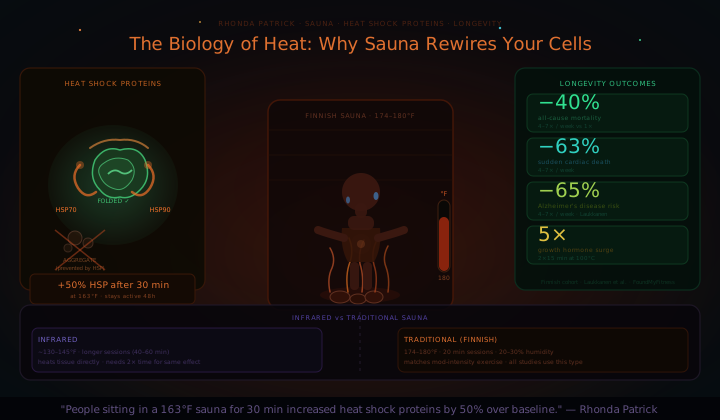
Sitting in a hot sauna for 30 minutes can increase heat shock proteins — your cells' molecular chaperones — by 50%. Those proteins stay elevated for 48 hours, preventing the kind of protein misfolding that drives Alzheimer's and muscular atrophy. Finnish cohort data shows men using sauna four to seven times a week have a 40% lower all-cause mortality and a 65% lower Alzheimer's risk. The mechanism behind all of it begins at the molecular level — and infrared sauna is not doing the same thing in the same timeframe.
Most people who use a sauna regularly think of it as relaxation with a side of sweating. The biology is considerably more interesting than that. What a hot sauna is doing at the cellular level — activating a class of protective proteins that prevent the kind of molecular damage linked to Alzheimer's disease, muscle loss, and accelerated aging — has been documented in human studies and confirmed across multiple species. The cardiovascular data from Finnish cohorts puts sauna in the same tier of risk-reduction as regular exercise. And the distinction between infrared and traditional sauna turns out to matter quite a lot if you are trying to get those effects.
What heat shock proteins are and why they matter
Inside every cell, proteins must maintain a precise three-dimensional shape to function. The shape determines function — an enzyme in the wrong conformation cannot catalyse its reaction; a structural protein that has unravelled cannot do its job. When cells are exposed to heat, that shape is at risk. The response evolution developed to handle this is the production of heat shock proteins (HSPs), a family of molecular chaperones whose job is to bind to proteins under stress and hold them in — or help them return to — their correct structure.
"Heat shock proteins play a pivotal role in preventing protein aggregation," Rhonda Patrick explains. When proteins misfold and the HSP system is not keeping pace, the damaged proteins accumulate rather than being degraded on schedule. They start binding to each other, forming aggregates. This is not an abstract concern: amyloid beta-42, the protein that aggregates in Alzheimer's disease pathology, is exactly this kind of misfolded aggregate. Mouse studies have shown that inducing HSP expression before exposing animals to amyloid beta-42 substantially protects against that aggregation.
The direct longevity signal is in the genetics. Individuals who carry a variant in the HSP70 gene that produces higher baseline HSP70 expression live longer — one copy of the variant is associated with a one-year increase in life expectancy; two copies with a two-year increase. In lower organisms, a single brief heat exposure extends lifespan by 15 to 20 percent. The mechanism is the same across species: better protein maintenance, less cumulative damage, slower functional decline.
Sauna produces this response in a measurable and durable way. Sitting in a 163°F sauna for about 30 minutes increases heat shock proteins by 50 percent above baseline. Crucially, that elevation persists for approximately 48 hours. This means frequency matters: if you are using sauna every two to three days, your HSP system is essentially running in an enhanced state continuously. People who are heat-acclimated — regular sauna users — also develop an augmented HSP response, triggering it faster and more robustly when exposed to heat stress.
The Finnish mortality data
The most consequential human evidence on sauna and longevity comes from Finnish cohort studies conducted by Jari Laukkanen and colleagues, following thousands of middle-aged men over two decades. The findings are striking in their dose-dependence.
Compared to men who used the sauna just once a week:
- Two to three sessions per week: 24% lower all-cause mortality, 23% lower coronary heart disease mortality
- Four to seven sessions per week: 40% lower all-cause mortality, 43% lower cardiovascular mortality, 63% lower sudden cardiac death
Stroke risk follows the same gradient — 14% lower at two to three sessions per week, 61% lower at four to seven. Hypertension risk drops 24% at two to three sessions and 46% at four to seven. These are not small effects. They are in the range of what regular vigorous exercise produces, which is why Rhonda Patrick describes sauna as an "exercise mimetic."
The cognitive disease data is equally compelling. Sauna use four to seven times per week is associated with a 65% lower risk of both Alzheimer's disease and dementia. One detail worth noting: the same study found that very extreme temperatures — above 200°F — were associated with a two-fold higher Alzheimer's risk compared to moderate temperatures. "There's no reason to go in a 212°F sauna," Patrick notes. The sweet spot in the Finnish data is 174 to 180°F.
Why sauna behaves like moderate-intensity exercise
The physiological overlap between sauna and exercise is not metaphorical — it has been tested directly. In a head-to-head comparison, participants either cycled on a stationary bike at 100 watts for 15 minutes or sat in a hot sauna for 15 minutes. The cardiovascular responses — heart rate, stroke volume, cardiac output — were identical during the activity. Both produced similar blood pressure improvement after the session.
Long-term sauna use improves blood pressure, left ventricular function, vascular compliance, and endothelial function. A single 30-minute Finnish sauna session lowers blood pressure, improves arterial compliance, increases heart rate variability, and increases parasympathetic activity. Observational data from Finland shows that people who both exercise and use sauna have a longer life expectancy than people who only exercise — suggesting the effects are additive rather than overlapping.
The mechanism is heat stress driving adaptations that are cardiovascularly beneficial: your heart works harder, cardiac output rises, and over time the system becomes more efficient and more resilient at rest.
Growth hormone: the overlooked effect
Sauna is one of the most powerful non-pharmacological stimuli for growth hormone release. The response is temperature and duration dependent. Two 20-minute sessions at 80°C with a 30-minute cooling interval between them doubles growth hormone levels from baseline. Two 15-minute sessions at 100°C separated by 30 minutes can produce a five-fold increase. The elevated growth hormone levels typically persist for one to two hours after the session before returning to baseline.
Growth hormone plays a direct role in muscle protein synthesis and in preventing sarcopenia — the loss of muscle mass with age that is itself a significant predictor of mortality. The sauna-induced growth hormone response provides a pathway through which regular heat exposure could contribute to muscle maintenance and the downstream longevity benefits that accompany it.
Infrared versus traditional sauna: what the comparison actually shows
Infrared saunas are widely marketed on the basis of the Finnish cardiovascular and longevity research — but that research was not conducted in infrared saunas. The distinction matters mechanistically.
Traditional Finnish saunas operate at 174 to 180°F with 20 to 30% humidity created by pouring water on heated rocks. Infrared saunas heat the body through infrared radiation rather than by heating the surrounding air, typically reaching only 130 to 145°F. When the same head-to-head comparison was extended to include infrared — moderate exercise, hot sauna, infrared sauna — the infrared condition at equivalent duration did not replicate the cardiovascular responses that hot sauna produced.
"For the same amount of time, infrared saunas do not do that," Patrick explains. "It's not the same at the same duration amount of time spent in the sauna." The lower ambient temperature means you are not generating the same core body temperature elevation in a 20-minute session that a Finnish sauna achieves.
This does not mean infrared sauna has no benefits — thermoregulatory mechanisms are still engaged, you sweat, and some data suggests benefits for heavy metal excretion. But to get the cardiovascular and HSP effects that the Finnish studies describe, you need to approximately double your infrared session time. "If you stay in an infrared sauna for 20 minutes, it's not going to be much with respect to cardiac output. If you stay in there for 40 minutes, you're going to get those effects." Patrick's personal preference is unambiguous: given the choice, she would build a Finnish sauna.
There is a separate category — far-infrared "Waon therapy" — used clinically in Japan at around 140°F for 45-minute daily sessions. The extended duration and daily frequency compensate for the lower temperature. This is a distinct protocol from the ambient infrared sauna sold for home use.
Protocol: what the data supports
The parameters that produced the Finnish outcomes are relatively specific. Temperature around 174 to 180°F. Duration of at least 20 minutes — below that threshold, the mortality risk reduction in the sudden cardiac death data was substantially dampened. Frequency of at least two sessions per week for minimum benefit; four to seven for maximum effect. The 20-minute threshold appears consistently as the point where effects become robust.
Growth hormone peaks from two sessions separated by a 30-minute cooling interval, with temperature driving the magnitude: higher temperature produces a larger response. Muscle atrophy data — people with immobilised limbs who were exposed to heat stress had 37% less muscle atrophy — suggests even irregular sauna use is worth doing during periods of forced inactivity.
Timing relative to sleep: allow at least two hours between sauna and bedtime for core body temperature to come down before sleep. However, heat exposure earlier in the evening may actually improve slow-wave sleep quality by the mechanism of deeper post-session cooling.
Hydration: expect to lose approximately 0.5 kilograms of sweat per session. Rehydrate before and after. For those new to sauna, acclimatisation happens quickly — starting at five minutes and extending by two or three minutes each session, most people reach the 20-minute threshold within a few weeks.
The 48-hour window
The practical implication of HSP elevation lasting 48 hours is worth emphasising. Using sauna every two days keeps the HSP system continuously primed. Combined with the fact that heat-acclimated individuals produce a faster and more robust HSP response, regular use compounds: each session builds on a system that is already running better than baseline. "The more frequently that you're exposing yourself to heat or exercise, which also raises your core body temperature, you're getting that heat shock protein response."
This is the shape of sauna's biology: short-term discomfort producing a cascade of molecular, cardiovascular, and hormonal adaptations that persist well beyond the session itself. The Finnish data on mortality reduction is not the story of a relaxation practice. It is the story of what happens when you regularly expose your cells to conditions they were built to respond to — and they respond exactly as evolution designed them to.