Fenbendazole Self-Medication: Three Cancer Patients, Three Case Reports
A peer-reviewed case series co-authored by Dr. William Makis describes three advanced-cancer patients who self-medicated with veterinary-grade fenbendazole without their oncologists' knowledge — two reached complete remission, one had disease progression halted — and the authors call for clinical trials to find out whether the drug played any causal role.
Dr. John Campbell covered a peer-reviewed paper describing three cancer patients who, without telling their treating doctors, self-medicated with veterinary-grade fenbendazole — a dewormer approved for dogs, not humans. This article follows his account of the paper. One of its co-authors is Dr. William Makis, a controversial figure in oncology who has been posting patient success stories on X and was also a co-author on an earlier paper Campbell has covered describing cancer as a metabolic disease treatable with three drugs — ivermectin, fenbendazole, and mebendazole — alongside lifestyle interventions.
Why This Paper Exists
All three patients were already in an advanced, dangerous state of disease. They turned to fenbendazole on their own, without medical supervision, because it is not approved for human use at all — only for veterinary use, in dogs. Campbell frames the paper's purpose carefully: the authors are not claiming fenbendazole works. They are explicit that patients should not be self-medicating with drugs whose human mechanism and dosing aren't established, and they use these three successful cases specifically to argue for the thing that's actually needed — clinical trials. As Campbell put it, doctors who see this kind of unexpected improvement in a self-medicating patient have something like a moral duty to publish it, because publishing case reports is the mechanism by which enough attention eventually builds toward a real trial.
Case One: Stage 4 Breast Cancer
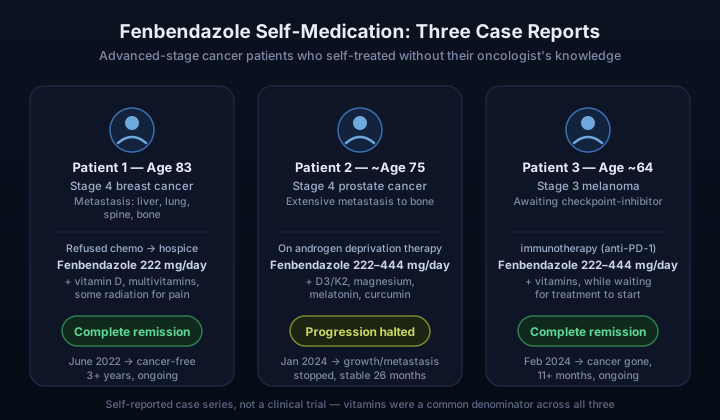
An 83-year-old woman had stage 4 breast cancer that had already metastasized to her liver, lungs, spine, and bones. She was offered chemotherapy and refused it, and was moved to hospice care. She then self-medicated with fenbendazole at 222 mg per day, along with vitamin D and some multivitamins, and also received some radiation for pain relief. By June 2022, her cancer was completely gone — a complete remission. As of the paper, she had been cancer-free for more than three years.
Case Two: Stage 4 Prostate Cancer
A man of roughly 75 had stage 4 prostate cancer with extensive metastasis to bone, and was undergoing androgen deprivation therapy (suppressing testosterone and other hormones that can drive prostate cancer growth). He self-treated with fenbendazole at doses between 222 and 444 mg per day, along with vitamin D with K2, magnesium, melatonin, curcumin, and other supplements. By January 2024, his cancer growth had stopped and metastasis had halted — not a complete remission like case one, but a clear stop to progression, holding stable for 26 months since.
Case Three: Stage 3 Melanoma
A man in his 60s (around 64) had advanced stage 3 melanoma and had been offered a checkpoint-inhibitor immunotherapy — an antibody drug targeting the PD-1 protein — but had to wait before starting it. While waiting, he self-medicated with fenbendazole at the same 222–444 mg range as case two, along with vitamins. Vitamins, in fact, were a common thread across all three patients. By February 2024, his cancer was completely gone — another complete remission, holding for more than 11 months since.
What the Paper Does and Doesn't Claim
Campbell is direct that oncologists will, correctly, tell patients not to do this — it's an unapproved medication with an uncertain human safety and dosing profile, and self-medicating with veterinary-grade drugs carries real risk, including the possibility of overdose even though the drug is generally considered very safe. But he also notes that patients will keep self-medicating regardless of warnings, and that when they come back with a dramatic improvement, publishing the case is how the medical field builds toward answering the actual question: does fenbendazole do anything here, and if so, at what dose? The paper's own position, in Campbell's account, is that this is hypothesis-generating — three encouraging case reports, not proof of a treatment.
Proposed Mechanisms, Still Unconfirmed
Campbell laid out several mechanisms suspected — not established — to explain why fenbendazole might affect cancer cells:
- Microtubule interference — microtubules act like a cell's internal skeleton; disrupting them can force a cell to self-destruct.
- Mitochondrial dysfunction — potentially pushing cells toward apoptosis (programmed cell death), partly via promoting the p53 tumor suppressor protein.
- Angiogenesis inhibition — possibly limiting a tumor's ability to grow new blood vessels.
- Interference with glucose and glutamine use — the fuel sources cancer cells often depend on.
- Action against cancer stem cells — relevant because incompletely killed cancer stem cells are one reason cancers recur after apparently successful treatment.
Campbell's Own Commentary
Campbell added his own hopes and caveats on top of the paper's findings. He said he hopes fenbendazole eventually proves useful as part of a combination therapy alongside more expensive treatments, rather than as a standalone drug — reasoning that a cheap, unpatentable drug is more likely to get proper investment and study if it's paired with something profitable, rather than competing against it. He was also careful to repeat, more than once, that none of this is proof: it's three self-reported case histories in patients who were also taking a range of vitamins and, in one case, radiation — not a controlled comparison against patients who didn't take fenbendazole.
Based on Dr. John Campbell's video "Fenbendazole + cancer: 3 patients, 3 remissions + word on Dr. William Makis (update #194)," covering a peer-reviewed case series co-authored by Dr. William Makis. Not a clinical trial. Not medical advice.