Sapolsky on Sexual Orientation: How the Limbic System Differentiates
Robert Sapolsky's lecture on the biology of sexual orientation distills behavioral genetics, the LeVay INAH-3 finding, the prenatal hormone window, and the fraternal-birth-order effect into one careful answer: orientation reflects how the limbic and hypothalamic circuitry differentiates before birth, in ways the person did nothing to choose.
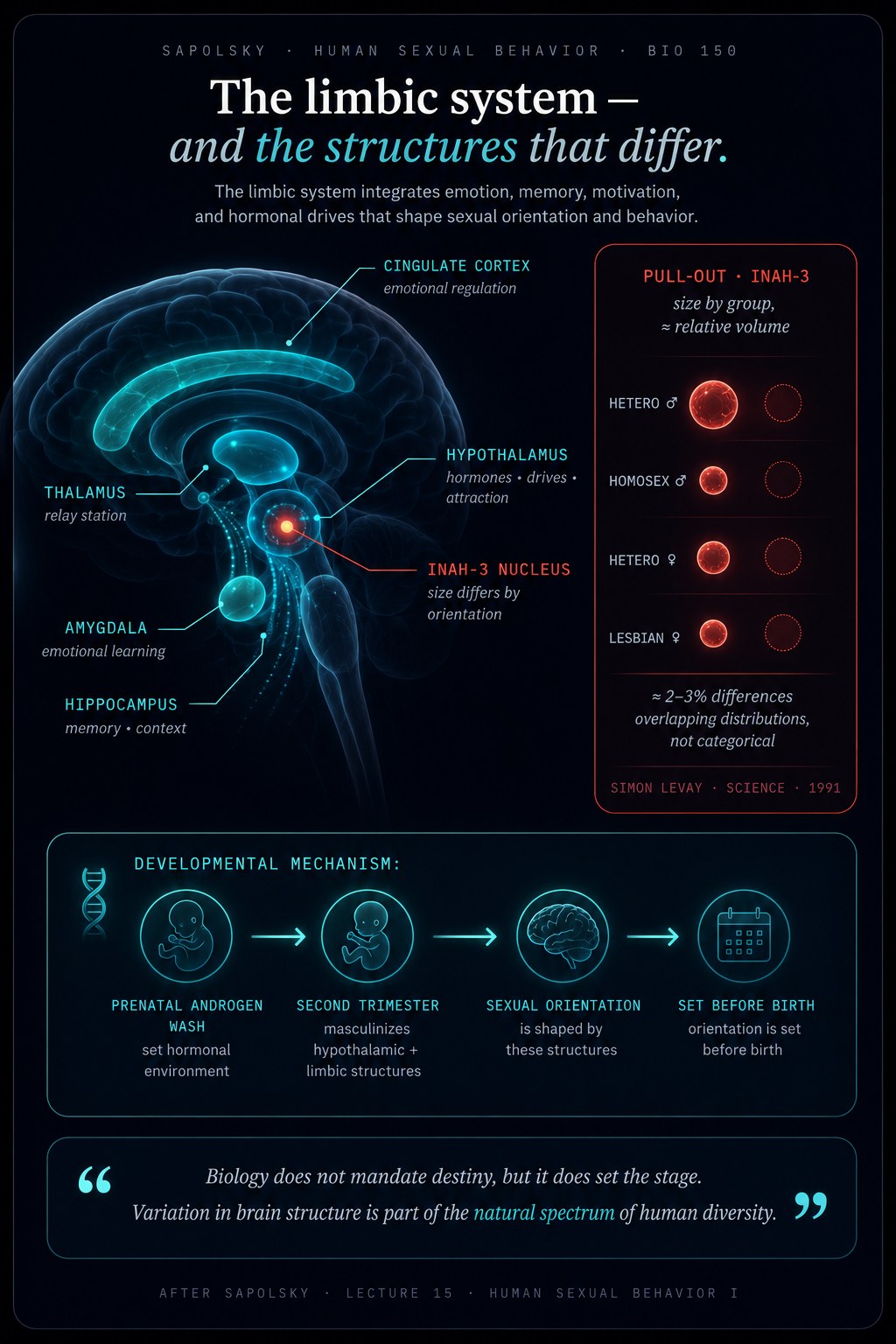
In his Stanford lectures on human sexual behavior, Robert Sapolsky walks students through what behavioral biology actually knows about the development of sexual orientation. The summary he gives is unfashionable in two opposite directions at once. Orientation is not a "lifestyle choice"; it is also not "100% genetic." It is, in his framing, what happens when a specific region of the brain—the limbic and hypothalamic circuitry—differentiates one way or another during a prenatal hormonal window the person did nothing to choose. What follows is a careful tour of what the data say.
The behavioral genetics floor
Twin studies on sexual orientation establish the baseline. The concordance for monozygotic twins is meaningfully higher than for dizygotic, which means heritability is non-zero. But the number that falls out is only around 30 to 40 percent—meaning most of the variance is not the genome. Sapolsky's classic move here: that is precisely the heritability range where "genes set the stage, the prenatal environment runs the show." He uses this to motivate the search for the developmental mechanism. If genes mattered overwhelmingly, concordance in identical twins would approach certainty. It does not. If genes mattered not at all, concordance would be no different from the population baseline. It is not that either. The twin data point to something else—something biological but not purely genetic, something that unfolds during development.
The hypothalamic finding
The 1991 Simon LeVay paper remains the landmark. LeVay, one of the all-time great neuroanatomists, examined post-mortem brain tissue and found that INAH-3—the third interstitial nucleus of the anterior hypothalamus—was roughly two to three times larger in heterosexual men than in homosexual men, on average. The homosexual-male size was statistically indistinguishable from heterosexual women. The study had limitations: cadaveric tissue, an AIDS-era cohort, modest sample size. Replication work over the following decades supports the broad finding, though with sharper edges and more careful controls. Sapolsky's framing: this is a small region, deep in the hypothalamus, that we now think encodes part of the sexual-orientation circuitry. He presents it not as definitive proof of a single anatomical switch, but as evidence that orientation has a neuroanatomical signature—that brains are, on average, organized differently depending on orientation.
What "wired differently in the limbic system" actually means
The limbic system is the brain's emotional and motivational circuitry—amygdala, hypothalamus, ventral tegmental area, nucleus accumbens, plus pieces of the hippocampus and cingulate. Sexual attraction, romantic bonding, and arousal run through these structures. The claim, distilled: in people of different orientations, these limbic structures are wired with different connection patterns and respond to different stimulus sets. This is not a value judgment; it is a description of organization. Sapolsky emphasizes that the same limbic system that "decides" who one is attracted to is the same one that handles fear, attachment, and reward—which is why orientation feels deep, involuntary, and constitutive of identity rather than arbitrary. The limbic system does not offer menu options. It generates motivation, and motivation does not feel like a decision. It feels like recognition.
The prenatal hormone window
The developmental mechanism centers on timing. Around the second trimester, the fetal brain receives a wash of sex hormones—androgens in particular—that masculinize or feminize specific hypothalamic and limbic structures. The classical evidence is animal: in rodents, manipulating prenatal androgen exposure reliably shifts adult sexual behavior. The human evidence is correlational but consistent. Congenital adrenal hyperplasia (CAH), in which XX fetuses receive elevated androgen exposure due to enzyme deficiency, raises the rate of non-heterosexual orientation in those individuals compared to the population baseline. Sapolsky's framing: orientation appears to be set in this prenatal window, well before birth, well before any "choice" is conceivable. The brain is being organized during a critical period, and what emerges later as attraction is the behavioral output of that organization.
The older-brother effect
One of the most replicated and unusual findings: the probability that a man is gay rises with the number of older biological brothers he has, by roughly 33 percent per older brother. The effect is specific to biological brothers, not adopted brothers or older sisters. The current best explanation: maternal immune response. The mother's body forms antibodies against male-specific proteins—Y-chromosome-linked antigens—from the first male fetus, which then affect brain development in subsequent male pregnancies. Each male pregnancy primes the immune system further. Sapolsky uses this as one of the cleanest examples of a non-genetic biological mechanism shaping orientation. The older-brother effect has no relationship to parenting, family dynamics, or postnatal environment. It is purely a matter of prenatal biology.
What it does NOT mean
Carefully: Sapolsky never says "a gene for being gay"—there isn't one. He never says "a man with INAH-3 of size X must be heterosexual"—these are population statistics with overlapping distributions, not categorical sorting bins. He never collapses orientation into a single anatomical feature. His framing is that orientation emerges from a polygenic substrate exposed to a specific prenatal hormonal environment, and the result is brain organization that biases the limbic system toward a particular target of attraction. This is biology speaking with appropriate epistemic humility. The data do not support determinism at the individual level; they support probabilistic organization at the population level. You cannot diagnose orientation from a brain scan. You can, however, describe the developmental processes that make one outcome more likely than another.
Why the framing matters
Sapolsky's stake is straightforward. If orientation is set prenatally by mechanisms the person did not choose, the long argument about its moral status collapses—it joins eye color, dominant hand, and stress responsivity as biological characteristics outside the realm of moral judgment. The clinical and political implications follow: conversion therapy is incoherent, parenting choices are not causal, and the question is not "why" in the sense of blame or justification but simply "how" in the sense of mechanism. The biology does not tell you what to value. It does tell you what is not up for negotiation.
Sapolsky's lecture is not advocacy. It is the careful summary of what behavioral biology can say, said by a scientist who has spent his life teaching this material. The answer he gives is the answer the data supports. Worth understanding even—perhaps especially—if you came to the topic with different priors.